What a Pomsky Inherits From the Pomeranian
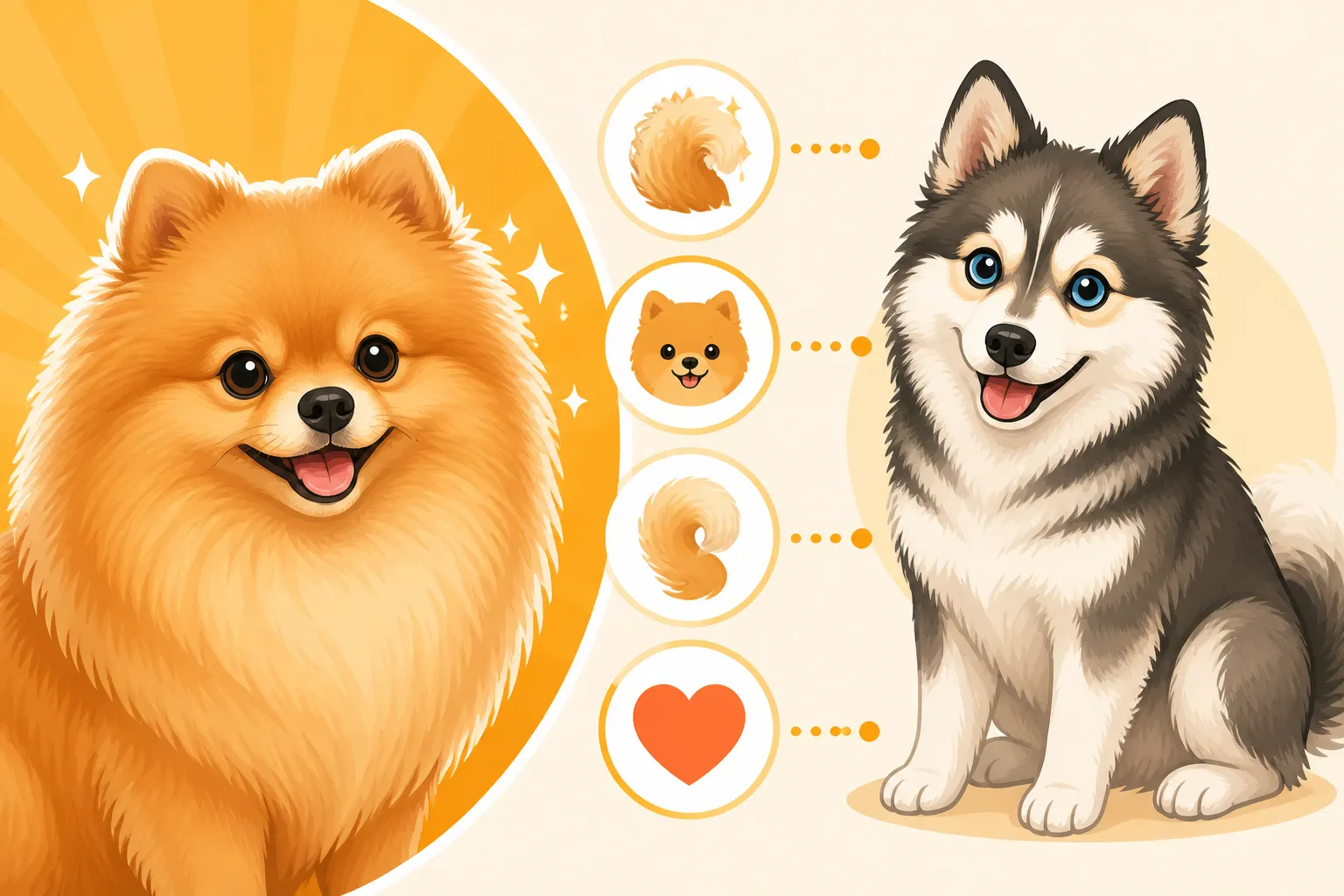
A Pomsky may inherit a Pomeranian’s alertness, fluffy double coat, and quick little-dog confidence, but there is no reliable recipe for how those traits will show up. Because a Pomsky is a Siberian Husky–Pomeranian cross, puppies in the same litter can differ in size, coat, energy, and temperament. This guide explains what a Pomsky might inherit—and what prospective owners should not assume.
What a Pomsky Can Inherit From Its Pomeranian Parent
A compact body and bold personality
Pomeranians are members of the German Spitz family, a group known for erect ears, thick coats, and alert expressions. Their small size does not make them timid by default: many are watchful, quick to notice activity, and eager to engage with the people around them. A Pomsky may inherit some of that confidence, but it can also inherit the Siberian Husky’s independence and social energy. The German Spitz Family a Pomeranian Belongs To
Size is one of the biggest uncertainties. A Pomeranian parent is small, while a Siberian Husky is considerably larger, so a Pomsky’s adult build may fall somewhere between the two—or lean more strongly toward one parent. Even puppies raised together can develop at different rates and finish at noticeably different sizes. A puppy’s current appearance is not a dependable promise of its eventual adult weight or height.
That unpredictability matters in ordinary life, not just when choosing a dog bed. A Pomsky who grows larger or stronger than expected may need more space, sturdier equipment, and different handling than a family planned for. If you are considering one, ask how the breeder estimates adult size, what both parents weigh, and whether the estimate is presented as a rough range rather than a guarantee. The history of the Pomeranian itself includes substantial size changes through selective breeding, so labels and puppy photos should not substitute for careful questions. How the Pomeranian Halved in Size in One Lifetime
A Pomeranian-influenced Pomsky might also be lively and people-focused, yet still need boundaries and patient training. Small-dog confidence can look like barking, rushing to greet visitors, or acting fearless around larger dogs. Those behaviors are not proof that a dog is stubborn or “bad”; they are signs that the dog needs calm, consistent guidance and safe introductions.
A fluffy coat that needs regular care
A Pomsky may inherit the Pomeranian’s dense double coat, the Husky’s thick coat, or a mix of coat qualities from both. A puppy’s fluff can be especially misleading: coat texture and fullness may change as the puppy matures. Even a Pomsky that looks less fluffy than its Pomeranian parent can still shed and need regular brushing.
A double coat usually includes a softer undercoat beneath longer guard hairs. It helps protect the dog, but it also means loose hair can collect in the coat and around the home. Regular brushing helps remove shed undercoat and catch small tangles before they become mats, particularly behind the ears, under the collar or harness, and around the legs. For more on the Pomeranian side of this coat type, see The Double Coat That Makes a Pomeranian and Why It Stays On.
Do not assume that a short haircut will make coat care easier or keep a Pomsky cooler. Clipping a double coat very short can affect how it grows back, and it does not remove the need to manage shedding. If you are unsure about a trim, ask a groomer familiar with double-coated dogs what can be tidied safely. The details of coat inheritance are explored in Whether a Pomeranian Mix Keeps the Coat.
At home, make grooming a gradual routine rather than an occasional wrestling match. Start with brief, gentle brushing sessions, reward calm behavior, and check the skin as you work. When choosing brushes, combs, or coat-care supplies, you might compare options through a retailer such as Chewy, but the tool should suit your dog’s coat and comfort—not just its breed label.
How Pomeranian Traits May Affect Daily Life
Alertness, barking, and communication
Pomeranians are often alert and quick to vocalize when they notice something. A Pomsky with that tendency may bark at hallway sounds, delivery people, dogs passing the window, or a visitor arriving at the door. A Husky-influenced dog may also be vocal in other ways, so a Pomsky’s sounds can vary from ordinary barking to more expressive calls.
It helps to distinguish alert barking from fear, excitement, frustration, or boredom. A dog who barks at the front window may be reacting to movement; a dog who barks when left alone may be distressed rather than simply making noise. Watch what happens immediately before the barking, what the dog’s body language looks like, and whether the behavior stops when the trigger disappears. Whether a Pomeranian Mix Barks the Same
Instead of shouting over the dog, reduce the trigger where possible and reward quiet behavior. For example, if the dog barks at people passing the window, use a gate or close the blinds during busy periods, then practice rewarding the dog for turning away from the view. Short training sessions and predictable routines can help, but persistent or escalating behavior may call for help from a qualified, reward-based trainer.
A Pomsky may be clever and responsive, but that does not mean training will happen automatically. A dog who is bored, under-exercised, or unsure what is expected can find its own entertainment—sometimes in the form of digging, chewing, or noisy attention-seeking. Keep sessions short, reward the behavior you want, and build difficulty gradually.
Activity needs and the size mismatch
Pomeranians are small, but they still need daily activity and mental engagement. Siberian Huskies were developed as working dogs and can bring substantial stamina and a strong interest in exploring. A Pomsky may inherit some of that drive, so do not plan on a dog who is satisfied with a quick trip outside simply because one parent is a toy breed.
The practical question is not whether every Pomsky needs the same exercise plan. It is how your individual dog responds to activity, weather, training, and rest. Some will enjoy longer walks and puzzle games; others may be less athletic or need a slower build-up. Puppies, older dogs, and dogs with health concerns should have exercise adjusted to their needs rather than pushed to meet an assumed breed target.
Use a well-fitted harness and secure leash, especially while recall is still developing. A Pomsky may be small enough to slip through a gap but energetic enough to cover ground quickly. A harness is also useful for managing leash pressure without relying on a collar. For practical comparison, Whether a Pomeranian Is Hardier Than It Looks offers context on why a small dog still needs thoughtful handling.
Before buying equipment, measure the dog rather than choosing by a “Pomsky” label. A retailer such as Chewy can be one place to compare harness styles and sizes, but fit matters more than brand: the harness should be secure without rubbing, restricting movement, or allowing the dog to back out. Recheck the fit as a puppy grows.
What to Expect From Health, Size, and Temperament
Inheritance is not a guarantee
A Pomsky can inherit traits from either parent, and not every characteristic is equally predictable. Coat color, markings, adult size, facial shape, energy level, and sociability can vary. Even a puppy that strongly resembles a Pomeranian may develop a more Husky-like build or temperament as it grows. Appearance alone cannot tell you exactly how a dog will behave or what health needs it may have.
Crossbreeding does not automatically mean a dog is healthier, either. Each parent can pass along inherited risks, and a mixed-breed dog may still need appropriate veterinary care and screening. Ask about health evaluations for both parents and request clear records rather than relying on claims such as “healthy lines” or “hybrid vigor.” A responsible breeder should welcome questions and explain what is known about the parents’ health.
It is also wise to consider the realities of Pomeranian health and structure, including concerns that can affect small dogs. A veterinarian can advise on routine examinations, dental care, weight management, and any screening that makes sense for your dog’s background. The article The Pomeranian Against the Other Toy Spitz Breeds provides broader breed context, but your own dog’s veterinary plan should be individualized.
Assessing a puppy beyond its appearance
When meeting a Pomsky puppy, look at how it responds to people, handling, ordinary household sounds, and its surroundings. A puppy that is briefly cautious may simply need time; a puppy that seems unusually shut down or distressed deserves careful discussion with the breeder. Ask how the litter has been socialized and what the puppies have experienced—not just which puppy has the “cutest” markings.
Meet the mother when possible and ask about the father’s temperament and health, even if he is not present. Find out how the breeder makes decisions about matching puppies to homes. Someone who asks about your schedule, experience, household, and expectations is more likely to be thinking about long-term fit than a seller focused only on making a quick placement.
Be cautious of promises that a Pomsky will remain a particular tiny size, shed very little, or have a guaranteed personality. A puppy can inherit a trait, but no description can make the outcome certain. If your household needs a reliably small adult dog, for example, a Pomsky’s size uncertainty may be a genuine mismatch rather than a minor detail. Whether Pomeranian Face Types Are Breeder Inventions
Preparing for Life With a Pomsky
Match your home to the dog you may get
Before bringing a Pomsky home, think through the everyday details: where the dog will sleep, how you will manage shedding, whether the household can provide activity and training, and who will care for the dog when you are away. A small puppy can still need close supervision, safe exercise, and gradual practice being alone. Its size does not mean it is automatically an easy apartment dog or a low-maintenance companion.
Travel plans deserve similar thought. Some dogs settle comfortably in a carrier or car; others need patient training and gradual exposure. If your Pomsky is small enough for a carrier, confirm that it fits comfortably and allows the dog to move naturally. Whether a Pomeranian Travels Well can help you think about travel from the Pomeranian side, but the Pomsky’s eventual size and temperament matter too.
A basic supply plan can prevent frantic shopping on the first night. Set up a safe resting space, food and water bowls, a leash and harness, grooming tools, and suitable toys. If you are comparing food or everyday care supplies, Chewy may be useful as one place to review available options; choose food with your veterinarian’s guidance, especially for a growing puppy.
| Trait or need | What the Pomeranian may contribute | What to plan for |
|---|---|---|
| Size | A smaller frame in some dogs | Adult size can vary; do not rely on a puppy photo |
| Coat | Dense, fluffy coat qualities | Shedding, regular brushing, and careful grooming |
| Temperament | Alertness and confidence | Training, socialization, and calm responses to triggers |
| Activity | Lively engagement | Needs may also reflect the Husky parent |
| Vocal behavior | Watchfulness and barking | Identify the cause and teach alternative responses |
| Equipment | Small-dog proportions in some Pomskies | Measure for fit and replace equipment as the dog grows |
Build routines instead of relying on breed stereotypes
The most helpful approach is to observe the dog in front of you. Track how much activity leaves your Pomsky content rather than overstimulated, which grooming tools it tolerates, and what situations trigger barking or worry. Keep notes during the first weeks. Those everyday patterns are more useful than expecting a dog to behave according to a label.
Create predictable routines for meals, toilet breaks, exercise, rest, and training. Reward calm behavior, introduce new people and places at a pace the dog can handle, and give the dog a quiet space to retreat. If your Pomsky is nervous, avoid forcing greetings or handling. If it is energetic, use appropriate play and training rather than expecting it to settle without an outlet.
Finally, keep your expectations flexible. A Pomsky can inherit the Pomeranian’s charm and compact look, but it may also inherit the Husky’s size, stamina, or independence—or a combination that is difficult to predict. A thoughtful match means welcoming the individual dog, not buying into a promise that it will be a miniature Husky, a fluffy Pomeranian, or some perfectly predictable blend.
Disclaimer
This article is for general informational purposes only and does not constitute professional advice. Laws, prices and regulations vary by location and change over time. Consult a qualified professional for guidance on your specific situation.