Teaching a Pomeranian to Lie on Its Side
Few things are as frustrating as trying to groom or administer medicine to a wriggly, uncooperative Pomeranian. Our little fluffballs are full of personality, and that often means they have strong opinions about being handled. But imagine a world where your Pom calmly lies on their side, making routine care, brushing, or vet examinations a peaceful, stress-free experience for both of you. This guide will walk you through the steps to teach your Pomeranian this incredibly valuable "lie on side" behavior, turning struggles into moments of connection.
Why Cooperative Side-Lying is a Game Changer for Your Pomeranian
Teaching your Pomeranian to lie calmly on their side isn't just a neat trick; it's a vital skill for their overall health and well-being. From essential grooming to necessary vet care, this one behavior can dramatically reduce stress and make life easier for everyone involved. It moves away from restraint and towards a partnership, giving your dog agency in their own care.
Enhancing Grooming Experiences
Pomeranians are famous for their magnificent double coats, which unfortunately, don't maintain themselves. They require regular brushing, combing, and sometimes even a sanitary trim to prevent mats and keep their skin healthy. Trying to navigate a squirming, possibly nippy Pom during these sessions can be a nightmare. When your dog is trained to lie on their side, areas like their belly, inner thighs, and underarms — common places for mats to form — become easily accessible.
This makes tasks like brushing out their britches, checking for skin issues, or carefully trimming the fur around their paw pads much simpler and less traumatic. Instead of dreading grooming time, it can become a calm, bonding experience. A cooperative Pomeranian is less likely to bite the brush or get injured from accidental slips, making the groomer's job (or yours!) significantly safer and more efficient. For more tips on making grooming easier, you might find Teaching a Pomeranian to Stand Still for the Brush helpful.
Simplifying Vet Visits and Health Checks
For many small dogs, the vet's office can be a scary place filled with strange smells, noises, and even stranger people wanting to poke and prod them. A Pomeranian that resists handling during a vet visit can make routine check-ups, injections, blood draws, or even simple abdominal palpations incredibly challenging and stressful.
By teaching your Pom to calmly lie on their side, you empower both your dog and your vet. This cooperative behavior allows for thorough physical examinations, much less stressful nail trims, and easier administration of medications or quick procedures. Imagine your Pomeranian calmly staying on their side for an ultrasound or an X-ray, reducing the need for excessive restraint or even sedation for minor issues. This skill contributes directly to reducing anxiety and building trust, transforming potentially traumatic events into manageable ones. It's especially crucial for procedures that might carry Anesthesia Risk in a Four Pound Pomeranian, where a calm demeanor can simplify the process for everyone.
Building Trust and Confidence
Beyond the practical benefits, cooperative care exercises like side-lying foster a deeper level of trust and confidence between you and your Pomeranian. When dogs learn that they have a choice, that their signals of discomfort will be heard and respected, and that participating calmly leads to positive reinforcement, they become more confident in handling situations.
This isn't about forcing your dog into submission; it's about teaching them that handling can be a pleasant, predictable experience where they play an active role. You're communicating that you're a safe partner, not a dominant controller. This shift in dynamic can reduce anxiety across many areas of their life, not just during grooming or vet care. Your Pomeranian learns that even when something feels a little weird, like a vet checking their teeth or eyes, you're there to guide them safely and reward their cooperation.
Breaking Down the "Lie on Side" Training Process
Teaching a Pomeranian to lie on their side requires patience, consistency, and breaking the behavior down into small, achievable steps. Remember, we're building a foundation of trust and positive association, not forcing a position.
Starting with a Comfortable Down Stay
Before you can ask your Pomeranian to roll onto their side, they need to be completely comfortable and reliable in a basic "down" position. This is your starting point, your home base, for the entire exercise. Choose a soft, non-slip surface, like a thick dog bed, a yoga mat, or a carpeted area, where your Pom feels secure.
Work on reinforcing a strong "down" command with high-value treats and enthusiastic praise. Your Pomeranian should be able to hold the "down" for increasing durations without getting up or becoming antsy. Keep these foundational sessions short and positive, ending before your dog loses interest. This step is about building focus and a positive association with settling down. For optimal training results, remember that Training Session Length for a Pomeranian should be brief, usually just a few minutes, to maintain their attention.
Luring into a Hip Rest
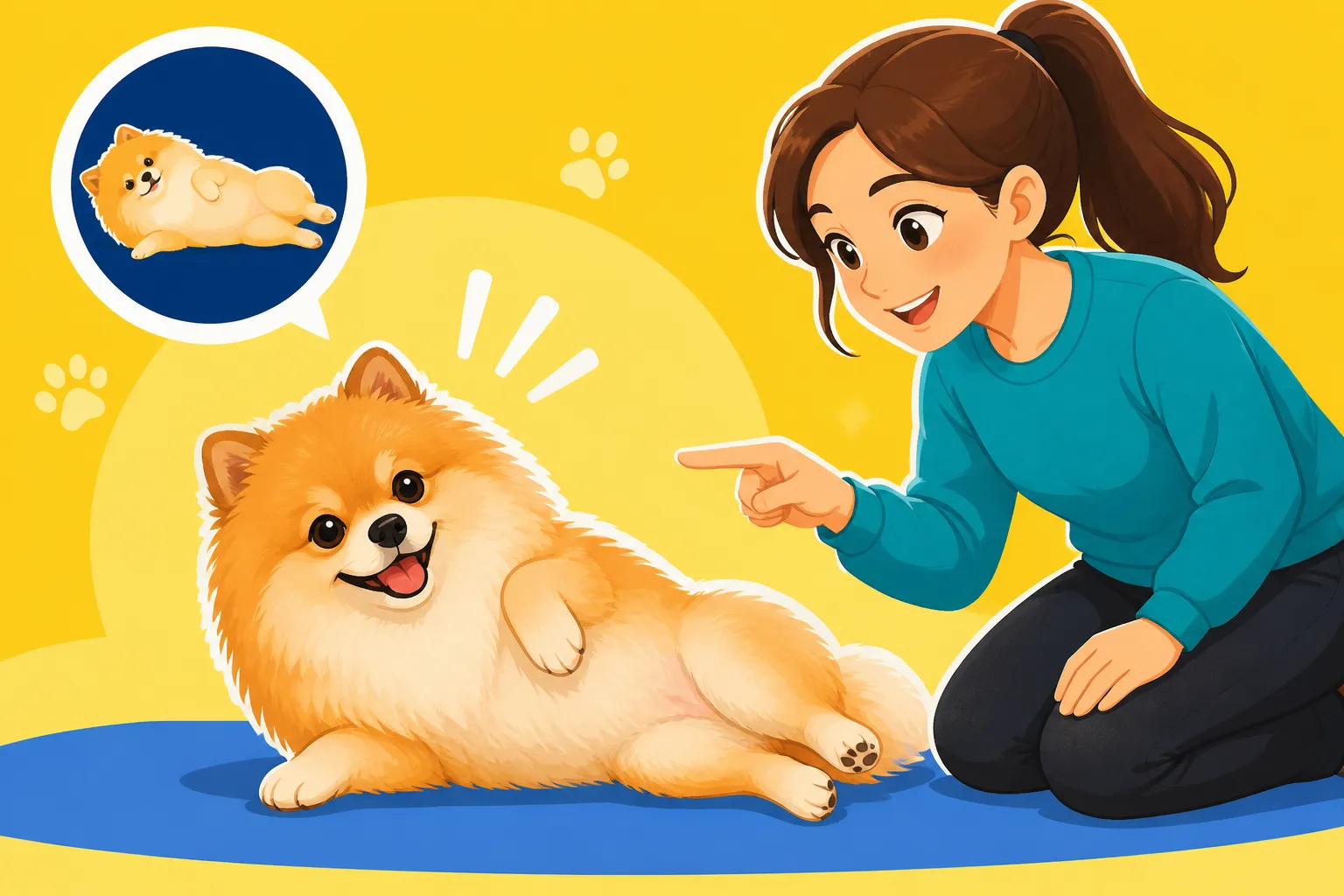
Once your Pomeranian has a solid "down," you can start to introduce the idea of shifting their weight. While they are in a "down," take a high-value treat and slowly move it from their nose towards their hip, aiming for the spot just above their tail. The goal is to encourage them to turn their head and body, naturally shifting their weight and causing one hip to settle more firmly on the ground, or even for them to partially roll onto their hip.
Don't expect a full side-lie in this stage. Reward any movement that brings them closer to the desired hip-resting position. Even a slight weight shift or a subtle turn of the head in the right direction deserves a treat and praise. Repeat this many times, always moving slowly and smoothly, letting the treat guide their natural movement. This teaches them that moving into this position earns a reward.
Gentle Pressure and Release
When your Pomeranian is consistently performing the hip rest with the lure, you can introduce a gentle guiding touch. While luring their head towards their hip with one hand, use your other hand to apply very light, consistent pressure behind their shoulder or on their hip, just enough to encourage a further roll.
The moment they roll onto their side, immediately release the pressure, say your positive marker word (like "Yes!" or "Good!"), and give them the high-value treat. The key is to make the release of pressure and the reward directly contingent on the action of rolling onto their side. This teaches them that their action makes the gentle pressure stop and brings a reward. The pressure should never be forceful or uncomfortable; it's a subtle cue, not a shove. Repeat this process until they are reliably rolling over with the combined lure and gentle touch.
Adding the Verbal Cue and Hand Signal
Now that your Pomeranian understands the physical motion, it's time to add the verbal command and a hand signal. Choose a clear, consistent word like "Side," "Relax," or "Lie Down Side." Simultaneously, create a distinct hand signal that you will always use for this behavior—perhaps a sweeping motion towards the side or a flat hand indicating a surface.
Say your chosen verbal cue just before you initiate the lure and gentle pressure. Over many repetitions, your Pomeranian will begin to associate the sound and the visual signal with the action. Eventually, you can start to fade out the physical lure and pressure, relying more on the verbal cue and hand signal alone. Practice this in various low-distraction environments to generalize the command.
Overcoming Common Hurdles in Side-Lying Training
Even with the best intentions, training a Pomeranian can come with its unique set of challenges. Their small size and independent nature can lead to some common struggles when teaching cooperative behaviors. Don't get discouraged; these hurdles are normal and can be overcome with patience and the right approach.
Dealing with Wiggling and Resistance
Pomeranians are known for their lively personalities, and sometimes that translates into a lot of wiggling or outright resistance during handling. If your Pom is constantly squirming, getting up, or simply refusing to roll, the most important rule is: do not force it. Forcing can create negative associations and make future training much harder.
Instead, go back a step or even break the behavior down into even smaller "micro-steps." Maybe for now, just rewarding a slight lean or a shift of weight is enough. Ensure your treats are truly high-value. Is it cooked chicken, a smear of peanut butter, or a favorite squeaky toy? The Reward a Pomeranian Actually Cares About might offer some fantastic ideas. End sessions before either of you gets frustrated, always on a positive note, even if it's just for a simple "sit." Short, positive interactions are far more effective than long, frustrating ones.
Managing Nipping and Growling
If your Pomeranian responds to your attempts at gentle pressure or positioning with nipping, growling, or snapping, it's a critical signal. This isn't defiance; it's a clear communication that they are uncomfortable, scared, or feeling threatened by the handling. You must stop immediately and re-evaluate your approach.
When a dog growls, they are giving you a warning before they escalate to a bite. Respect that warning. You need to focus on desensitizing them to touch and building positive associations with handling, separate from the side-lying training itself. Work on getting them comfortable with being touched all over their body, starting with areas they tolerate and gradually moving to more sensitive spots. Use gentle strokes followed by high-value treats. Resources like Getting a Pomeranian Through an Exam Calmly or even The Month a Pomeranian Puppy Stops Nipping can provide valuable strategies for addressing discomfort with handling and touch.
Ensuring the Environment is Calm and Safe
The environment plays a huge role in the success of any training, especially for a small, sensitive breed like a Pomeranian. A chaotic or noisy setting is distracting and can heighten your dog's anxiety, making it impossible for them to focus and learn.
Choose a quiet time of day when there are no other pets, children, or loud noises to interrupt. Pick a designated training spot that is calm and free from distractions. A secure, non-slip surface is also crucial; if your Pomeranian feels unstable or like they might slip, they will be less likely to relax and comply. A soft mat not only offers comfort but also signals a predictable and safe space for these specific training sessions.
Tools and Aids to Facilitate Training
While the core of training relies on positive reinforcement and clear communication, certain tools and resources can make the process smoother and more effective for both you and your Pomeranian.
High-Value Treats and Reinforcers
For a tiny Pomeranian, motivation is everything. Their discerning palates mean that plain old kibble might not cut it for challenging new behaviors. You need to pull out the big guns: high-value treats that are irresistible to your dog. Think small, soft, and smelly items that can be quickly consumed without distraction.
Consider tiny pieces of cooked chicken, lean beef, cheese, or specialized training treats from brands that use wholesome ingredients. Break them into pea-sized portions to avoid overfeeding and keep your Pom eager for the next reward. Varying the type of high-value treat can also keep your Pomeranian engaged and excited about training. Discovering The Reward a Pomeranian Actually Cares About will be a game-changer for all your training endeavors.
Using a Soft Mat or Bed for Comfort
The surface your Pomeranian trains on can significantly impact their comfort and willingness to cooperate. A hard floor or a slippery surface can make the rolling motion feel awkward or even insecure for a small dog. Using a soft, comfortable mat or a familiar dog bed can make a world of difference.
A yoga mat provides a non-slip surface and some cushioning, while a plush dog bed can feel extra inviting. This dedicated training surface not only offers physical comfort but also acts as a visual cue for your Pomeranian, signaling that it's "training time" and a safe space for them to relax and engage in the requested behavior. This sense of security can reduce anxiety and increase their readiness to learn.
Leveraging Online Training Resources
Sometimes, seeing the behavior demonstrated or having access to expert guidance can be incredibly helpful. If you're struggling to get started or hitting a roadblock, don't hesitate to explore online training resources. Many reputable platforms offer comprehensive programs that include cooperative care exercises like teaching a dog to lie on their side.
For instance, platforms like BAXTER & Bella offer online puppy schools and training programs that can guide you through these steps with video demonstrations and support. They break down complex behaviors into simple, followable instructions, often with troubleshooting tips for common issues. Additionally, online retailers like Amazon carry a wide array of dog training books and video courses that can provide alternative methods or deeper insights into positive reinforcement techniques. These resources can be invaluable for refining your technique and gaining confidence in your training abilities.
Integrating "Lie on Side" into Daily Life
Once your Pomeranian has grasped the "lie on side" command in a controlled training setting, the next crucial step is to integrate it seamlessly into their daily life. This generalization ensures that the behavior is reliable when you truly need it, whether for grooming, health checks, or just quiet relaxation.
Regular Practice for Maintenance
Like any learned skill, "lie on side" needs regular practice to stay sharp. Don't wait until you have a real need for it. Incorporate short, positive practice sessions into your daily routine. Even a quick 30-second session where you ask your Pomeranian to lie on their side, reward them, and release them can help maintain the behavior and reinforce the positive association.
Think of it as muscle memory for your Pom. The more consistently they practice it, the more automatic and comfortable it becomes. Vary the locations where you practice—different rooms in the house, a quiet corner in the yard—to help them understand that the command applies everywhere. Remember, consistency is key to building a reliable response.
Applying the Skill to Grooming Routines
This is where all your hard work truly pays off. Once your Pomeranian is confidently offering the side-lying position, start to weave it into your regular grooming sessions. Before you begin brushing their belly or working on their hindquarters, ask them to "side." Reward their compliance immediately.
Initially, you might only be able to perform a few strokes of the brush or a quick check of their paw pads before they want to get up. That's perfectly fine! Reward the effort and short duration, then release them. Gradually, over time, you can extend the duration and the amount of handling you do while they are in the side-lying position. If they get antsy, pause, reset, and go back to a simple "side" and reward. This systematic approach will build their tolerance and cooperation. For detailed guidance on specific grooming tasks, consider reading Teaching a Pomeranian to Stand Still for the Brush to complement this skill.
Preparing for Vet Appointments
Vet visits can be a source of stress for many small dogs. Proactively preparing your Pomeranian for handling during these appointments by using the "lie on side" command can make a significant difference. Before a scheduled visit, practice the command at home, then simulate vet-like handling. Gently touch their paws, lift their ears, examine their teeth, and lightly palpate their abdomen while they are on their side.
This helps desensitize them to the types of touches they'll experience at the clinic. You can even bring high-value treats to the vet's office to reinforce the behavior there. Communicate with your veterinarian that you've been working on cooperative care; many vets are thrilled to work with owners on this and will use the opportunity to reinforce the calm behavior. Having a Pomeranian that can calmly undergo examinations, particularly for delicate procedures where Whether a Pomeranian Needs Pre-Anesthetic Bloodwork is a consideration, contributes immensely to their safety and your peace of mind.
Here's a quick overview of the side-lying training journey:
| Stage of Training | Goal | Key Techniques | Common Challenge |
|---|---|---|---|
| Foundation | Solid "Down" | Lure, treat, positive marker word | Short attention span |
| Initial Roll | Shift weight to one hip | Lure head to hip with high-value treat | Resistance to leaning |
| Full Side-Lie | Consistently roll onto side | Gentle guiding pressure, lure, immediate reward | Wiggling, getting up |
| Cue Association | Responds to verbal cue and hand signal | Add cue before lure/pressure, fade physical cues | Relying on lure too long |
| Generalization | Performs in various settings and contexts | Practice in different rooms, during light grooming, with distractions | Regression in new places |
Disclaimer
This article is for general informational purposes only and does not constitute professional advice. Laws, prices and regulations vary by location and change over time. Consult a qualified professional for guidance on your specific situation.