What Puts a Pomeranian Out of the Ribbons
It's incredibly frustrating when you've poured your heart and soul into raising and preparing your beautiful Pomeranian for a dog show, only to see them consistently miss out on those coveted ribbons. You know your little fluffball is perfect in your eyes, but the judges sometimes see things differently. This comprehensive guide will walk you through the precise details of the Pomeranian breed standard, helping you understand the specific characteristics and subtle nuances that can unfortunately put a Pom out of the ribbons in the show ring, from their physical traits to their temperament and presentation.
Understanding the Pomeranian Breed Standard – The Blueprint for Success
For any breed to maintain its distinct characteristics, there needs to be a clear, written description of the ideal dog – this is the breed standard. For Pomeranians, this standard is the definitive blueprint that judges use to evaluate every dog in the ring. It's not just a suggestion; it's a meticulously detailed guide covering everything from size and coat to temperament and movement. When a judge looks at your Pomeranian, they're comparing it against this ideal, looking for how closely your dog embodies these characteristics. Deviations from the standard are called "faults," and some significant deviations are even considered "disqualifications," meaning the dog cannot be awarded any ribbon at all. Understanding this document is the absolute first step in figuring out why a Pom might not be placing.
The Pomeranian's Ideal Size and Weight
One of the most immediate and easily identifiable aspects of the Pomeranian breed standard concerns its size and weight. The standard is quite specific here: mature Pomeranians should generally weigh between 3 and 7 pounds. This isn't just an arbitrary number; it's integral to the breed's historical development and purpose as a companion animal. A Pomeranian that falls outside this range, either too light or too heavy, immediately deviates from the ideal set forth by the standard.
Imagine bringing a Pomeranian into the ring that tips the scales at 8 or 9 pounds. While this dog might be a beloved pet and perfectly healthy, its size would be considered a significant fault by a judge. It's simply too large to fit the compact, toy-breed ideal. Conversely, a Pomeranian that is exceptionally tiny, perhaps under 3 pounds, might also face challenges. While the "teacup" trend has grown in popularity, a Pom that is too fragile or appears underdeveloped due to extreme smallness can also be faulted. The standard emphasizes a sturdy, albeit small, build, not one that seems delicate or frail. These size discrepancies, even if minor, can be enough to push a dog out of contention, especially in competitive classes where dogs are very evenly matched in other aspects. For more on this, you might find The Three to Seven Pounds a Pomeranian Is Allowed particularly enlightening.
The Importance of Bone Structure and Proportions
Beyond just overall weight, the Pomeranian breed standard places significant emphasis on correct bone structure and body proportions. The ideal Pomeranian should be compact and short-backed, conveying an image of strength and agility despite its small size. This isn't just about aesthetics; correct structure ensures the dog moves efficiently and is sound. Judges are looking for a body that is well-balanced, where the length of the body is slightly less than the height at the shoulders, creating that desirable "square" appearance.
Faults in this area can include a long back, which can make the dog appear less compact and more prone to spinal issues. A dog with fine bones might be perceived as delicate rather than sturdy, while one with heavy bones might look coarse. Legs should be straight and parallel when viewed from the front or rear, with appropriate angulation at the shoulders and stifles (knees) to allow for smooth, free movement. A dog that is too straight in the shoulder or too over-angulated can have an awkward gait. Similarly, a roached (arched) or sway (dipped) back can disrupt the clean topline required by the standard. These structural deviations, even if they don't impact the dog's ability to live a happy pet life, fundamentally alter its silhouette and movement, making it less likely to catch a judge's eye for the top placements.
The Magnificent Coat – When Beauty Becomes a Fault
The Pomeranian's double coat is arguably its most defining feature, the lavish "mane" that turns heads and draws admirers. But within the show ring, this coat isn't just about fluff; it's about adherence to a very specific set of characteristics. While a general onlooker might see any voluminous coat as beautiful, a judge is scrutinizing its texture, density, and how it presents. When the coat deviates from these exacting standards, it can definitely be a reason a Pomeranian doesn't make it to the top.
Texture, Density, and Condition
The breed standard explicitly describes the Pomeranian's coat as a "double coat" consisting of a soft, fluffy undercoat and a long, straight, harsh-textured outer coat of guard hairs. This combination is what gives the Pomeranian its characteristic "stand-off" appearance, making it look larger and rounder than its actual body size. The density of the undercoat is crucial; it should be profuse, providing insulation and support for the guard hairs. For a deeper dive into this, check out The Double Coat That Makes a Pomeranian and Why It Stays On.
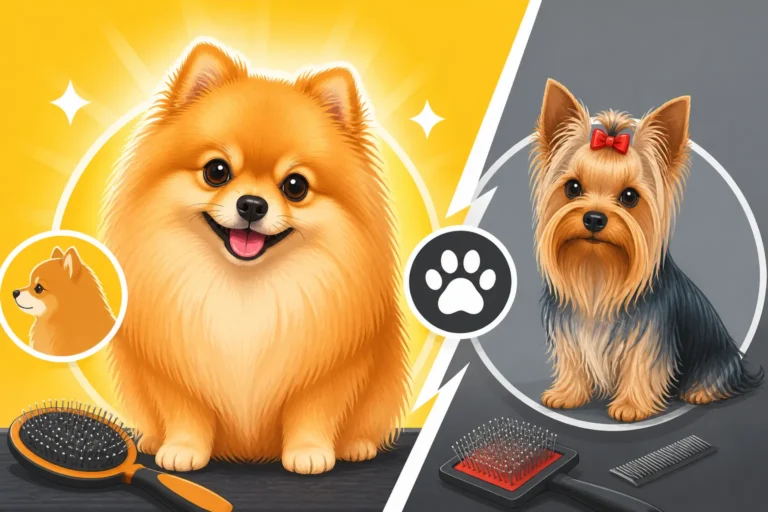
Where a Pomeranian can run into trouble in the ring is if its coat lacks this specific texture or density. A coat that is too soft, silky, or woolly, for example, is considered a fault. These textures don't allow the coat to stand off the body as it should, resulting in a flatter, less impressive outline. Similarly, an "open" coat, where the hairs lie flat rather than standing erect, or a sparse coat lacking sufficient undercoat, will be penalized. Judges are looking for that full, buoyant, puffball silhouette, and anything that detracts from it, such as a coat that parts easily or looks straggly, will certainly put a dog out of the ribbons. Even if the dog has plenty of hair, the quality and structure of that hair are paramount. This is why Pomeranian owners dedicate so much time to grooming, to ensure their dog's coat is presented in its absolute best condition, free of mats, clean, and perfectly fluffed. You can find many of the tools you need for this at Chewy, from high-quality brushes to shampoos designed to maintain coat health.
Color, Markings, and Acceptable Patterns
One of the most exciting aspects of the Pomeranian breed is the incredible array of colors and patterns it comes in. The breed standard is quite inclusive, stating that "all colors, patterns, and variations thereof are permissible and must be judged on an equal basis." This means whether your Pom is orange, black, white, sable, parti-color, or blue, it should theoretically have an equal chance, as long as the color itself is recognized. You might want to explore Every Color a Pomeranian Comes In for a full appreciation of this diversity.
However, even with this broad acceptance, there are nuances and, more importantly, certain patterns that are not recognized by many major kennel clubs and are considered disqualifications in the show ring. The most prominent example of this is the merle pattern. While merle Pomeranians exist and are bred by some, the merle gene can be associated with serious health issues, particularly when two merle dogs are bred together, leading to vision and hearing problems. Because of these health concerns, many breed standards explicitly state that merle is a disqualifying fault. So, while a merle Pom might be stunning to look at, it will not be able to compete for top honors in a conformation show that adheres to these standards. This is a common point of confusion and disappointment for owners who might unknowingly acquire a merle Pom with show aspirations, only to find it cannot compete. For more specific details, you could read Whether a Merle Pomeranian Is Recognized.
Head, Expression, and Essential Features
A Pomeranian's head and facial features are critical to its breed type and overall expression. Beyond the fluffy coat, it's the face that truly communicates the dog's personality and adherence to the standard's ideal. Judges spend a great deal of time evaluating the head, looking for a particular blend of refinement, intelligence, and charm. Any significant departure from these specific traits can certainly place a Pomeranian out of the ribbons.
The Desired Fox-Like Expression and Small Ears
The breed standard calls for a "fox-like" expression, which is quite specific. This means the head should be proportionate to the body, with a moderately broad skull that tapers to a fine muzzle. The eyes are particularly important: they should be dark, almond-shaped, and set neither too far apart nor too close together. They should convey an alert, intelligent, and inquisitive expression. Any deviation, such as round, large, or light-colored eyes, can soften or change that distinctive fox-like look, making the dog less typical of the breed.
Equally crucial are the ears. Pomeranian ears should be small, erect, and set high on the head. They contribute significantly to the alert and foxy appearance. Ears that are too large, low-set, or that fold or "break" can drastically alter the head's balance and expression. Imagine a Pom with ears that flop slightly; while endearing to a pet owner, a judge would see this as a clear fault. These seemingly minor details are actually major components of the overall breed picture and are carefully assessed. For further insight into these specific traits, consider reading The Small Erect Ears a Pomeranian Should Have. The overall impression should be one of refinement and alertness, not a heavy or coarse head, or one that seems out of proportion to its dainty body.
Bites, Teeth, and Pigmentation
The condition of a Pomeranian's mouth, specifically its bite and teeth, is another area where a judge will be very attentive. The standard mandates a "scissor bite," meaning the outer side of the lower incisors should fit snugly behind the inner side of the upper incisors. This is considered the ideal and most functional bite for most breeds. Any deviation, such as an undershot bite (where the lower jaw protrudes beyond the upper) or an overshot bite (where the upper jaw extends significantly over the lower), is considered a fault. For specific information on this, you can check out Whether an Undershot Pomeranian Is Disqualified.
Beyond the bite, the number and condition of the teeth are also important. While some breeds allow for missing teeth, Pomeranians are generally expected to have a full set, or at least no significant omissions that compromise the bite structure. Retained puppy teeth, which often happen in toy breeds like Poms, can also be a fault if they interfere with the proper growth of adult teeth or the bite. Poor dental health, though often a result of owner care (or lack thereof), can also be seen as a negative, as it impacts the overall health and presentation of the dog. Finally, pigmentation plays a role: the nose, eye rims, and lips should be dark, typically black, unless the dog is a dilute color (like blue or chocolate), in which case the pigmentation should match the coat color. Pink spots on the nose or unpigmented eye rims are considered faults, as they detract from the refined expression. Ensuring your Pomeranian's teeth are well cared for with regular brushing, perhaps using products from Chewy, can contribute positively to its presentation in the ring. You can learn more about specific dental expectations in The Mouth a Pomeranian Judge Looks Into.
Movement and Tail Carriage – The Dynamic Presentation
A dog show isn't just about static beauty; it's also about dynamic presentation. Judges need to see how a Pomeranian moves, as proper movement is a direct indicator of correct structure and soundness. Furthermore, the way a Pomeranian carries its tail is a significant breed hallmark that distinguishes it from many other breeds. Both of these elements are crucial, and faults in either area can prevent a Pomeranian from earning a ribbon.
The Pomeranian's Gait and Soundness
When a Pomeranian moves around the ring, judges are looking for a specific type of gait: it should be free, balanced, and brisk. This means the dog should move with purpose and grace, covering ground efficiently. From the front and rear, the legs should move in parallel, neither weaving nor paddling, and from the side, the movement should appear smooth and unencumbered. A sound dog is one whose structure allows it to move correctly and effortlessly, without any signs of lameness or discomfort. You can delve into this topic further by reading The Movement a Pomeranian Shows in the Ring.
Unfortunately, many structural faults manifest clearly in a dog's movement. For example, a Pomeranian with luxating patellas (slipping kneecaps), a common ailment in small breeds, might exhibit a "skip" in its gait, where it momentarily holds up a back leg. While a low grade of patellar luxation might not cause pain, it's still a deviation from perfect soundness and will be noted as a fault. Other issues like straight shoulders or poor angulation can lead to a restricted, choppy gait or a "hackney" action, where the dog lifts its front feet too high, similar to a trotting horse. Crabbing, where the dog moves with its body slightly angled rather than straight, can also be a fault. These movement faults are significant because they indicate underlying structural imperfections, which are directly contrary to the breed standard's emphasis on soundness. A judge must consider not only what the dog looks like standing still but also how it functions in motion.
Tail Set and Plumage
The Pomeranian's tail is one of its most charming and characteristic features, and the breed standard describes it with precision. It should be set high and lie flat and straight over the back, ideally with the plume (feathering) spread evenly over the back. This high-set, proudly carried tail contributes significantly to the Pom's overall balanced and foxy silhouette. It's an integral part of their distinctive outline and presence in the ring. To understand the specifics, take a look at The Tail a Pomeranian Carries Over Its Back.
Faults in tail carriage can include a tail that is too low-set, meaning it doesn't arch high enough over the back. A tail that drops to the side or curls tightly into a ring, rather than lying flat, would also be considered incorrect. The quality of the tail's plume is also important; it should be well-feathered and profuse, continuing the opulent theme of the double coat. A sparse tail or one with insufficient feathering would lack the desired "plume" effect. While these might seem like minor details, they are part of the overall picture of breed type and balance. A beautifully moving Pomeranian with an otherwise perfect coat and head could still be faulted if its tail carriage is significantly off, impacting its chances of earning top ribbons.
Temperament and Presentation in the Ring
While a significant portion of judging focuses on physical attributes, the Pomeranian's temperament and how it is presented in the ring are equally vital. A dog can be physically perfect, but if it's unruly, shy, or poorly groomed, it simply won't shine. The show ring demands a combination of ideal physical traits and a cooperative, confident demeanor.
The Confident and Alert Demeanor
The Pomeranian breed standard describes the ideal temperament as "lively, intelligent, and extroverted." A Pom should exude confidence and be alert to its surroundings, showing keen interest without being overly agitated or nervous. When a judge approaches to examine the dog, it should stand calmly, allowing the hands-on inspection without shying away, growling, or attempting to nip. This is part of being a well-socialized and stable dog, which is a core expectation for any breed. While a Pomeranian may be small, it certainly shouldn't be timid.
A Pomeranian that exhibits shyness, fear, or aggression in the ring will be severely penalized. Shyness, often evidenced by tail tucking, cowering, or attempting to hide from the judge, indicates a lack of confidence that goes against the breed's spirited nature. Aggression, even if it's just a growl or a snap, is a disqualifying fault in most breed standards because it poses a safety risk and reflects an unsuitable temperament for a companion animal. Even if your Pomeranian is just a bit "stubborn or just bored," as discussed in Whether a Pomeranian Is Stubborn or Just Bored, it needs to present its best, most cooperative self. Owners must work diligently on early socialization and training to ensure their Poms are comfortable and confident in busy, noisy environments like dog shows. Without a sound temperament, all the physical perfection in the world won't earn a ribbon.
Grooming and Handler Etiquette
While not explicitly part of the written breed standard, meticulous grooming and polished handler etiquette are absolutely non-negotiable for success in the show ring. A judge can only assess what they can see, and a poorly groomed dog hides its best features and can even make its faults appear worse. The Pomeranian's coat, in particular, requires significant preparation. This means the coat must be impeccably clean, free of mats, and brushed out to achieve maximum stand-off. Dirt, grease, or a matted coat will instantly detract from the dog's appearance and indicate a lack of proper care. Many owners rely on professional groomers, and understanding The Grooming Bill Nobody Warns a Pomeranian Owner About can give you perspective on the investment. Regular grooming appointments, perhaps monthly at a cost similar to The 60 to 90 Dollar Pomeranian Grooming Appointment, are essential for maintaining a show-ready coat.
Beyond the dog's presentation, the handler's skill and behavior in the ring are also crucial. A handler who is proficient can subtly stack their dog to highlight its best angles, move it at the ideal speed to showcase its gait, and generally make their dog look its absolute best. Conversely, an inexperienced or clumsy handler can inadvertently obscure their dog's good points or draw attention to its flaws. Ring etiquette, such as being aware of other exhibitors, moving smoothly, and following the judge's instructions, also contributes to a positive impression. While a judge isn't "judging the handler," a well-presented dog with a skilled handler often stands out, while a dog with a messy coat or an awkward handler might unfortunately find itself out of the ribbons.
Common Faults and Disqualifications Summary
To help clarify, here's a quick overview of some common reasons a Pomeranian might not place in a show, categorized by the type of issue.
| Category | Common Faults | Disqualifications |
|---|---|---|
| Size & Structure | Over or under standard weight | (No general DQs, but severe faults will eliminate) |
| Long or sway back, fine or coarse bone | ||
| Poor angulation, legs not straight | ||
| Coat | Soft, silky, woolly, or open coat | Merle pattern |
| Sparse undercoat, lack of stand-off | ||
| Insufficient or uneven feathering | ||
| Head & Face | Round, large, or light-colored eyes | |
| Large or low-set ears | ||
| Undershot or overshot bite (severe) | Severe overshot/undershot bite (varies by club) | |
| Missing teeth (multiple), retained puppy teeth | ||
| Pink spots on nose, unpigmented eye rims | ||
| Movement | Skipping, crabbing, hackney gait | Lameness (constant) |
| Restricted or unbalanced movement | ||
| Tail | Low-set tail | |
| Tail not lying flat on back | ||
| Temperament | Shyness, timidity, nervousness | Aggression, viciousness |
| Lack of cooperation during examination | ||
| Presentation | Matted, dirty, or unkempt coat | (Not DQs, but will prevent placement) |
| Poor handler presentation |
Understanding these specific points outlined in the breed standard is key for any owner hoping to succeed in the show ring. It's a journey of continuous learning, grooming, and training, all aimed at presenting a Pomeranian that truly embodies the ideal of its magnificent breed.
Disclaimer
This article is for general informational purposes only and does not constitute professional advice. Laws, prices and regulations vary by location and change over time. Consult a qualified professional for guidance on your specific situation.