The Movement a Pomeranian Shows in the Ring
Understanding how a Pomeranian moves in the show ring can feel like deciphering a secret code, especially when you're watching these little fluff balls glide around and aren't quite sure what the judges are truly evaluating. It's not just about speed or enthusiasm; there's a very specific, historical standard of gait that speaks volumes about a Pom's underlying structure and health. This guide will help you understand the nuances of what makes a Pomeranian's movement truly exceptional, or what might send them home without a ribbon.
Understanding the Ideal Pomeranian Gait in the Show Ring
When a Pomeranian enters the show ring, its movement, or gait, is one of the most critical aspects a judge will assess. It's not just a casual stroll; it's a performance that reveals the dog's structural integrity, balance, and athletic ability. For many owners, it can be perplexing to understand what constitutes a "good" gait versus a "faulty" one, especially when the dog's luxurious coat can obscure a lot of the underlying mechanics.
The Importance of a Balanced, Effortless Stride
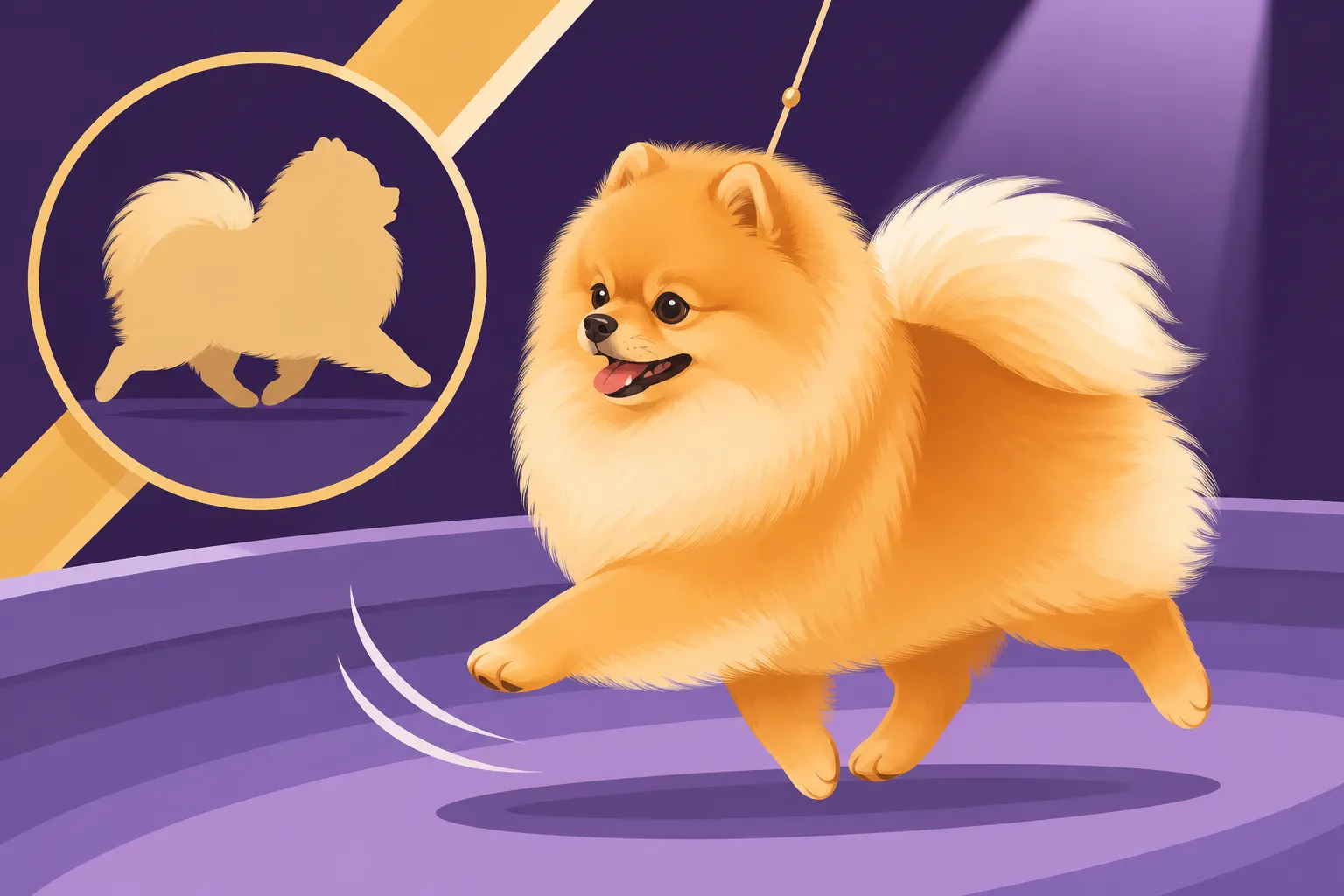
The ideal Pomeranian gait is described as balanced, brisk, and free, demonstrating reach and drive. What does "balanced" truly mean here? It means that the front and rear assemblies work in harmony, propelling the dog forward without any wasted energy or awkwardness. Imagine a tiny, perfectly oiled machine, moving with grace and purpose. When a Pomeranian is moving correctly, its steps should be even, and its topline should remain level, showing no signs of dipping or rising excessively with each stride.
An effortless stride implies that the dog isn't struggling or exerting undue effort to move. This is a tell-tale sign of sound structure. A Pom with good angulation and proper bone structure will appear to float across the ground, its movements fluid and unconstrained. Contrast this with a dog that looks stiff, short-strided, or as if it's working hard to maintain its pace. Such observations immediately raise questions about underlying issues, even if the dog is energetic. This effortless quality is something a judge looks for keenly, as it speaks directly to the breed's historical soundness and vitality.
Reach and Drive: The Mechanics of Proper Movement
"Reach" refers to the forward extension of the front legs, while "drive" refers to the powerful propulsion from the rear legs. In an ideal Pomeranian gait, these two components are perfectly synchronized. The front legs should extend freely from the shoulder, neither reaching too far forward nor taking too short a step. You want to see a natural, comfortable extension that covers ground efficiently. Think of it like a pendulum swing: smooth and consistent.
The drive from the hindquarters is equally, if not more, important. The rear legs should push off the ground with strength, extending well behind the dog's body, providing the momentum for forward movement. This drive comes from strong muscles and correct angulation in the hips and stifles. When a Pomeranian has excellent drive, its powerful rear enables it to cover significant ground with minimal effort. Without adequate drive, a dog might appear to "pitter-patter" or take short, choppy steps, failing to exhibit the desired ground-covering gait. A judge will watch closely to ensure that the rear feet track efficiently, neither crossing nor interfering with each other. This combination of powerful drive and graceful reach creates the desired balanced and efficient trot.
Observing Movement from All Angles
Judges don't just glance at a Pomeranian; they observe its movement from every conceivable angle to get a complete picture. First, they'll ask the handler to trot the dog away from them in a straight line. Here, they're looking for parallelism of the hind legs. The pads of the feet should ideally be visible, showing a straight line of travel, neither too close (cow-hocked) nor too wide. Then, the dog will be trotted back towards the judge. This is where they assess the front assembly, again looking for straight, parallel movement of the forelegs, with the elbows held close to the body and the paws tracking directly forward.
Finally, the dog will be trotted in a circle or triangle pattern, allowing the judge to evaluate the overall side gait. This view is crucial for assessing reach and drive, the level topline, and the tail carriage. The Tail a Pomeranian Carries Over Its Back should be high-set and lie flat over the back, moving with the dog but not flapping excessively. This circumferential view allows for a holistic appraisal of how all parts of the Pomeranian's anatomy work together as a cohesive unit. Any wobbling, bouncing, or unevenness will be noticeable, indicating potential structural weaknesses. A well-presented Pomeranian should hold its head proudly, its luxurious The Stand Off Coat a Pomeranian Must Have flowing as it moves, creating a truly magnificent spectacle.
Structural Foundation and Its Impact on Movement
At the heart of a Pomeranian's ability to move correctly in the show ring lies its foundational structure. You see, the way a dog is put together — its bones, muscles, and ligaments — directly dictates how it can move. It's like building a house; if the foundation isn't solid, no matter how pretty the paint job, the house won't stand the test of time, and in a Pom's case, it won't move efficiently or soundly. This is why breeders spend so much time studying pedigrees and evaluating their dogs' conformation.
Angulation: The Building Blocks of a Sound Gait
Angulation refers to the angles formed by the bones at the joints, particularly in the shoulder and hip. For a Pomeranian, proper angulation is paramount for achieving that desirable reach and drive. In the front, a well-laid-back shoulder provides the necessary leverage for good forward reach. If the shoulder blade is too straight (straight shoulder), the dog will have a limited reach, resulting in short, choppy steps. It's like trying to row a boat with tiny paddles – you just won't get far.
Similarly, correct angulation in the hindquarters is what creates that powerful drive. The hock joint should be well-bent, and the stifle (knee) should also show appropriate angulation. Too straight in the rear, and the dog loses its spring and propulsion, leading to a weak, pushing gait rather than a driving one. Too much angulation, and the dog might appear to crouch or over-reach, leading to inefficient movement. The balance between front and rear angulation is critical; they must complement each other for a truly balanced gait. A common visual for ideal angulation is imagining a series of gentle curves, ensuring smooth transitions and efficient energy transfer as the dog moves. The Six to Seven Inches a Pomeranian Measures in height means every fraction of an inch in angulation counts proportionally more than in a larger breed.
Topline and Tail Set: How They Influence Flow
The topline of a Pomeranian—the line from behind the shoulders to the tail—should be level and firm when standing, and it should remain relatively level and firm while the dog is in motion. A weak or roached (arched) topline can indicate structural instability that will undoubtedly affect movement. If the back sways or bounces excessively as the dog trots, it suggests a lack of muscle tone or spinal integrity, which hinders the smooth flow of the gait. This isn't just an aesthetic flaw; it points to a functional weakness that compromises the dog's ability to move efficiently and comfortably.
The tail set, the point where the tail emerges from the spine, also plays a subtle but important role. A high-set tail carried flat over the back is characteristic of the breed and contributes to the overall silhouette and balance of the dog in motion. While not directly influencing the mechanics of the stride, an improperly carried or low-set tail can be an indicator of a weak hindquarter or poor overall conformation, detracting from the harmonious picture a judge seeks. A strong, level topline supports the entire structure, allowing the legs to do their job without undue stress on the back. This is part of the holistic assessment of What Puts a Pomeranian Out of the Ribbons in a show.
The Role of Pasterns and Feet
While often overlooked by the casual observer, the pasterns (the equivalent of a human's wrist, just above the foot) and the feet themselves are crucial components of sound movement. The pasterns should be strong, firm, and slightly sloping, acting as shock absorbers. If the pasterns are weak or "down," they can bow inward or outward, causing instability and an inefficient gait. It's like trying to run with wobbly ankles; you'll lose power and risk injury. Strong pasterns allow for proper push-off and landing, providing crucial support.
The feet should be small, compact, and "cat-like," with well-arched toes and thick pads. They are the direct point of contact with the ground, so their health and structure are vital. Splayed feet, flat feet, or those with thin pads can lead to discomfort, fatigue, and an unnatural gait over time. Think about wearing ill-fitting shoes; it impacts every step. Good feet provide traction and support, allowing the Pomeranian to exhibit that brisk, free movement. A judge will typically feel a dog's pasterns and feet to check for firmness and structure, understanding that these seemingly minor details contribute significantly to the overall soundness of the dog's movement. You can find quality foot care products, like paw balms and nail trimmers, from online retailers like Chewy to help maintain healthy feet.
Common Movement Faults and What They Indicate
Even the most beautiful Pomeranian with the most dazzling coat can be severely faulted in the ring if its movement is unsound. These faults aren't just cosmetic; they often point to underlying structural problems that can impact a dog's long-term health and quality of life. Understanding these common errors can help you appreciate the intricate standards of the breed and what makes a truly well-built dog.
Crabbing, Paddling, and Hackney Action
These are some of the more frequently observed gait faults in the show ring, and each tells a story about the dog's construction.
- Crabbing (or Sidewinding): This occurs when a dog moves with its body at an angle to its direction of travel, seemingly moving sideways. It often happens because the rear legs are tracking inside or outside the front legs, leading to interference if the dog tries to move in a perfectly straight line. To avoid hitting itself, the dog crabs. This is a common symptom of unbalanced angulation or improper leg length ratios, where the front and rear assemblies aren't working together harmoniously. It's often seen from the rear or front view when the dog is moving away or towards the judge.
- Paddling: This fault is typically observed in the front legs. Instead of moving straight forward, the dog's front feet swing out to the side in an arc, resembling a paddling motion. This can be caused by loose shoulders or an overly narrow chest, indicating a lack of firmness in the front assembly. It wastes energy and reduces the efficiency of the stride, making the movement less effortless.
- Hackney Action: This is perhaps one of the most distinctive faults, often described as a high-stepping, exaggerated front action, much like a hackney horse. The dog lifts its front paws high off the ground, often bending at the pastern. While it might look flashy to the untrained eye, it is considered a severe fault in a Pomeranian as it indicates an extremely straight shoulder and sometimes an insufficient layback, preventing proper reach. Instead of a smooth, ground-covering stride, the hackney gait is choppy and inefficient. A judge wants to see a functional trot, not a prancing show-off.
Unsoundness: When Structure Fails the Gait
Beyond specific faults like crabbing or paddling, judges are always looking for overall "unsoundness." This is a general term for any structural flaw that prevents a dog from moving correctly, efficiently, and without strain. Unsoundness can manifest in many ways, from a weak topline that sways with every step to a severe Slipping Kneecaps in a Five Pound Pomeranian (patellar luxation) that causes a skip or hop in the hind leg. These issues are not just about aesthetics; they are often indicative of genetic predispositions and can lead to pain or arthritis later in life.
For example, a dog with an improperly fused skull (a wide-open fontanelle, as seen in some "teacup" Pomeranians) might have a bouncy, uncoordinated gait due to neurological issues, or a dog with a collapsing trachea might have a hesitant gait to avoid exacerbating its breathing. What Teacup Breeding Costs a Pomeranian often includes compromised structure that impacts movement. A structurally unsound Pomeranian might also exhibit short, stilted steps, a lack of extension, or appear to be moving on eggshells. The goal of breeding, and thus judging, is to produce dogs that are not only beautiful but also capable of moving with the agility and endurance befitting their Spitz heritage.
Coat vs. Movement: Not Always What It Seems
One of the unique challenges with judging Pomeranian movement is their incredibly dense, double coat. The Double Coat That Makes a Pomeranian and Why It Stays On can sometimes obscure minor structural flaws or, conversely, create an illusion of better movement than is actually present. A judge must learn to look through the coat to the underlying bone and muscle. For instance, a beautifully groomed, well-conditioned coat can make a dog appear to have more substance and better angles than it possesses. However, a discerning judge will feel the dog's bone, observe its gait closely, and understand that coat is merely presentation, not structure.
Conversely, a dog with a magnificent coat might have excellent movement that is simply enhanced by the flow of its hair. It's a double-edged sword! A handler might try to compensate for a minor gait fault by careful grooming or pacing, but a good judge will always prioritize the functional structure. This is why you'll often see judges asking handlers to gait their dogs at different speeds – a dog that moves well at one speed but falls apart at another usually has a structural issue. Ultimately, while the coat is a defining feature of the breed, it should never overshadow the importance of sound, efficient movement, which is the true testament to a Pomeranian's health and breed type.
Training and Presentation for Optimal Movement
Even a structurally sound Pomeranian needs proper training and presentation to showcase its best movement in the show ring. It's not enough for the dog to have good movement; it needs to show it consistently and confidently. This involves physical conditioning, learning ring etiquette, and building a strong partnership between dog and handler.
Conditioning for Stamina and Muscle Tone
Just like any athlete, a show Pomeranian needs to be in peak physical condition. This doesn't mean marathon running, but rather consistent, moderate exercise to build stamina and maintain muscle tone. Regular walks, interspersed with short bursts of trotting, can help develop the necessary leg strength and endurance. Keep in mind How Far a Pomeranian Can Walk in a Day; they are small, so their exercise needs are different than a larger breed. Activities like playing fetch in the yard, controlled short jogs on a leash, or even swimming (if introduced safely and carefully) can contribute to overall fitness. A fit dog will move more energetically and sustain its gait for longer periods without tiring.
Muscle tone is especially important for maintaining a firm topline and powerful hindquarter drive. Without sufficient muscle, even a dog with good bone structure might appear soft or weak in motion. Diet also plays a crucial role; feeding a high-quality, balanced diet supports muscle development and overall health. You might even consider joint supplements, available on Chewy, to support their tiny, hardworking joints, especially as they get a little older or if they're particularly active in training. Remember, a dog that is overweight or out of shape will struggle to move freely and efficiently, and judges will notice the sluggishness.
Mastering the Loose Lead and Proper Pacing
One of the biggest factors in presenting a Pomeranian's movement well is the handler's skill on the lead. The dog should be trotted on a loose lead, which means the lead should have a slight slack and not be pulled taut. A tight lead can restrict the dog's movement, especially in the head and neck, preventing it from extending fully and naturally. The goal is for the dog to move freely alongside the handler, dictating its own pace rather than being dragged or rushed.
Proper pacing is equally important. The handler needs to find the "sweet spot" speed where their individual Pomeranian looks its best. For some, this might be a brisk trot; for others, a slightly slower pace allows their unique structure to shine. Too fast, and the dog might break into a gallop or become uncoordinated; too slow, and it might appear sluggish or lose its drive. Practicing in various environments and on different surfaces will help both dog and handler learn to maintain this optimal pacing. Online resources and books often provide guidance on lead handling techniques, and you can find specialized show leads and collars at retailers like Chewy.
Handling Nerves and Distractions in the Ring
The show ring environment is full of distractions: other dogs, handlers, judges, spectators, and strange noises. A Pomeranian's movement can be significantly impacted by nerves or lack of focus. A dog that is fearful or anxious might move stiffly, tuck its tail, or simply refuse to gait properly. This is where early and consistent socialization comes in. Exposing your puppy to various sights, sounds, and people from a young age can build confidence. Bringing Up a Pomeranian Puppy Its First Year should include opportunities to experience new things calmly.
Training in mock ring settings, perhaps with friends acting as judges and other dogs present, can help the Pomeranian get accustomed to the environment. The handler's calm and confident demeanor is also crucial; dogs pick up on our emotions. Positive reinforcement, using high-value treats or toys as rewards, helps make the experience enjoyable and builds a strong bond, encouraging the dog to perform its best. Ultimately, a confident, happy Pomeranian that enjoys its time in the ring will invariably present its movement more effectively, allowing its true structural merits to shine through to the judge. Understanding Whether a Show Pomeranian Differs From a Pet often comes down to this level of specialized training and conditioning.
Summary of Ideal Pomeranian Movement
To help illustrate the differences between ideal movement and common faults, here's a quick reference table. Keep in mind that judges are looking for a harmonious balance across all these characteristics.
| Aspect | Ideal Pomeranian Movement | Common Faults |
|---|---|---|
| Overall Gait | Balanced, brisk, free, effortless, ground-covering | Stilted, choppy, hesitant, sluggish, uncoordinated |
| Front Legs | Good reach, straight tracking, elbows held close | Paddling (swinging out), too wide/narrow, hackney action |
| Rear Legs | Powerful drive, straight tracking, hocks well-bent | Crabbing (sidewinding), cow-hocked, too wide/narrow |
| Topline | Level, firm, stable in motion | Swaying, roached (arched), dipping |
| Pasterns | Strong, firm, slightly sloping, good shock absorption | Weak, down, soft, bowing inward/outward |
| Feet | Small, compact, cat-like, well-arched toes | Splayed, flat, weak pads, turning in/out |
| Tail Set | High-set, carried flat over back, moves with dog | Low-set, flagging, carried too high/low |
| Angulation | Balanced front and rear, appropriate angles for reach/drive | Too straight (front or rear), over-angulated |
Disclaimer
This article is for general informational purposes only and does not constitute professional advice. Laws, prices and regulations vary by location and change over time. Consult a qualified professional for guidance on your specific situation.