The Norwegian Elkhound and the Pomeranian’s Northern Roots
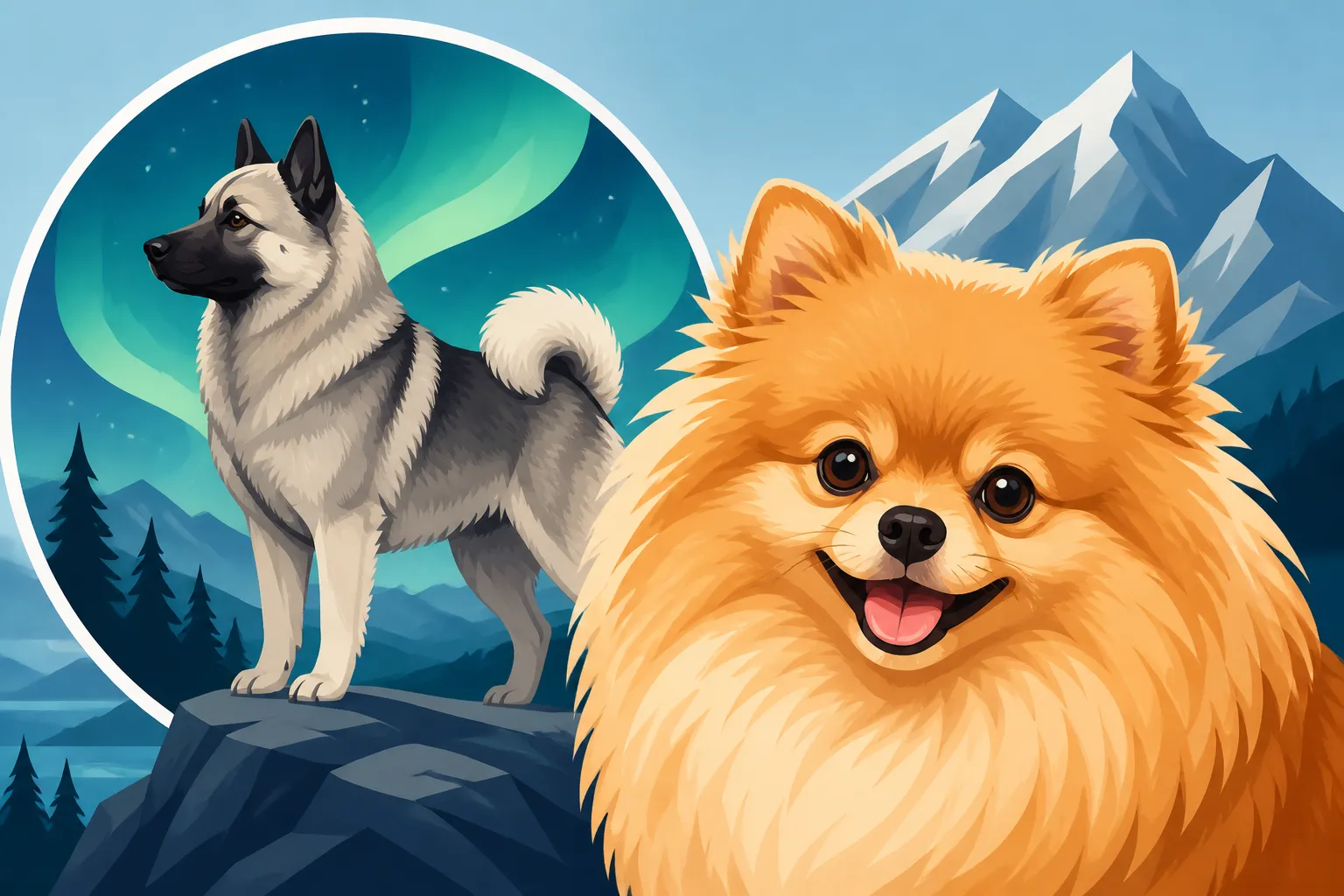
The Norwegian Elkhound and the Pomeranian can both look unmistakably northern: erect ears, curled tails, dense coats, and alert expressions. That resemblance can make it tempting to assume one breed descended directly from the other. The better explanation is more nuanced: they belong to a broad family of Spitz-type dogs, but their shared traits do not establish a direct parent-and-child relationship.
What the two breeds share
The Spitz traits behind the resemblance
The Norwegian Elkhound and the Pomeranian are members of the wider Spitz family, a group of breeds known for features such as prick ears, a curled or carried tail, a double coat, and a wedge-shaped or foxlike face. These traits create a familiar outline, even when two dogs differ greatly in size, working history, and the places where their modern breeds developed.
A dense coat and upright ears made practical sense for many dogs living in cold climates. Erect ears can help a dog orient toward sounds, while a thick coat provides insulation. A curled tail is a common feature among many Spitz breeds. Those features appear across a broad range of dogs, though, so seeing them in both breeds does not show that the Pomeranian came from the Norwegian Elkhound.
This is an important distinction when discussing breed ancestry. A shared appearance can reflect common ancestors far back in the history of dogs, similar environmental pressures, or selective breeding for familiar Spitz features. It is not, by itself, proof of a direct connection between two named breeds.
The similarities and differences at a glance
The two breeds share an overall northern Spitz look, but their roles and modern forms are quite different. The Norwegian Elkhound is a sturdy hunting dog associated with Norway. The Pomeranian is a toy companion breed whose history is tied to the larger German Spitz family and the Pomerania region of Europe.
| Feature | Norwegian Elkhound | Pomeranian |
|---|---|---|
| Breed group connection | Nordic Spitz-type hunting dog | Small member of the German Spitz family |
| Historical association | Norway and hunting traditions | Pomerania and European companion-dog development |
| Original scale and role | Medium-sized, robust working dog | Descended from larger Spitz-type dogs and selectively bred smaller |
| Shared visible features | Dense coat, upright ears, curled tail | Dense coat, upright ears, curled tail |
| What the resemblance establishes | A shared broad Spitz type | A shared broad Spitz type, not direct descent from the Elkhound |
The scale difference is especially striking. The Elkhound has the build and stamina of a working dog, while the Pomeranian is a very small companion. For more on how the Pomeranian became so compact, see How Breeders Selected Pomeranians Down in Size. Its ancestors were not simply miniature Norwegian Elkhounds; the Pomeranian’s story is connected to the European Spitz family.
Where the Pomeranian’s northern roots lead
Pomerania and the German Spitz family
The Pomeranian takes its name from Pomerania, a historical region along the southern Baltic coast. The region’s borders and political identity changed over time, so the name does not point to a modern country in the way a simple map label might. The breed’s history is better understood through its association with the wider German Spitz tradition than through a claim that it came from Norway.
The dogs that preceded today’s Pomeranian were larger than the tiny companions many people know now. Over generations, breeders selected smaller dogs, gradually producing a compact companion with the familiar Spitz coat and expression. That history helps explain why a Pomeranian can look like a reduced version of a larger northern dog while still belonging to a distinct breed lineage.
The name can be confusing because Pomerania is associated with northern Europe, and the Pomeranian shares a northern-looking silhouette with Scandinavian breeds. But geography alone does not establish a route of descent. The Pomeranian’s regional name and the Norwegian Elkhound’s Norwegian identity are separate clues in two different breed histories. For additional context, Where Pomerania Sits and Why the Breed Is Named for It explores the region behind the name, while The German Spitz Family a Pomeranian Belongs To explains the Pomeranian’s closer breed-family context.
The Elkhound’s Norwegian working background
The Norwegian Elkhound developed as a hardy hunting dog in Norway. The breed is associated with following and locating large game, including moose, and its sturdy frame reflects the demands of outdoor work. It is not a toy version of a Pomeranian or a dog bred mainly to serve as a lap companion.
Its history is often described as ancient, but claims about exact dates or a single origin point should be treated carefully. Dogs in northern Europe have been used for work over long periods, and modern breed labels were applied later than the earliest working dogs themselves. A historical dog with a curled tail and a thick coat cannot automatically be identified as a modern Norwegian Elkhound.
The same caution applies when tracing the Pomeranian. Breed histories often simplify gradual change into a neat origin story, but dogs and their roles evolved over time. The Elkhound’s working heritage and the Pomeranian’s development within European Spitz populations provide useful context; they do not prove that one modern breed directly produced the other.
Did the Norwegian Elkhound contribute to the Pomeranian
Shared ancestry is not the same as direct descent
It is reasonable to say that the two breeds share a broad Spitz background. It is much harder to support a claim that the Pomeranian descended specifically from the Norwegian Elkhound. Breed families contain many related dogs, and traits can be shared across multiple branches without one breed being the direct ancestor of another.
Think of it like two branches that share older roots. Their present-day resemblance may come from distant common ancestry, while each branch developed its own characteristics and history. Without reliable evidence linking a particular line of Norwegian Elkhounds to the dogs that became Pomeranians, a direct-descent claim goes beyond what appearance alone can tell us.
The wording matters. Saying “the Pomeranian and Elkhound are both Spitz-type dogs” is a cautious description of their broader relationship. Saying “the Pomeranian came from the Norwegian Elkhound” is a much more specific historical claim and needs stronger evidence. For a wider view of the family connection, The Working Spitz the Pomeranian Descends From and Whether the Pomeranian Is Actually German provide useful related background.
Why similar dogs can develop similar features
Breeders have often favored traits that suited a dog’s job or appealed to people choosing a companion. A thick coat, upright ears, and a curled tail are not unique markers that identify a particular ancestor. They are features seen in multiple breeds, sometimes because of shared ancestry and sometimes because similar traits were useful or preferred in different places.
There is also a difference between a breed’s history and the deeper history of domestic dogs. Named breeds are comparatively recent, organized populations shaped through selection. The ancestors behind them may have belonged to broader regional dog populations long before modern breed standards existed. This makes it possible for two breeds to be related at a broad level without having a simple, documented link between their modern forms.
That is why a family resemblance should be treated as a starting point for learning, not the final answer. The Pomeranian’s small size and companion role emerged through its own selection history, while the Elkhound retained a larger working-dog form. Their shared Spitz outline is meaningful, but it does not erase those distinct paths.
How to describe the connection accurately
A careful way to explain the relationship
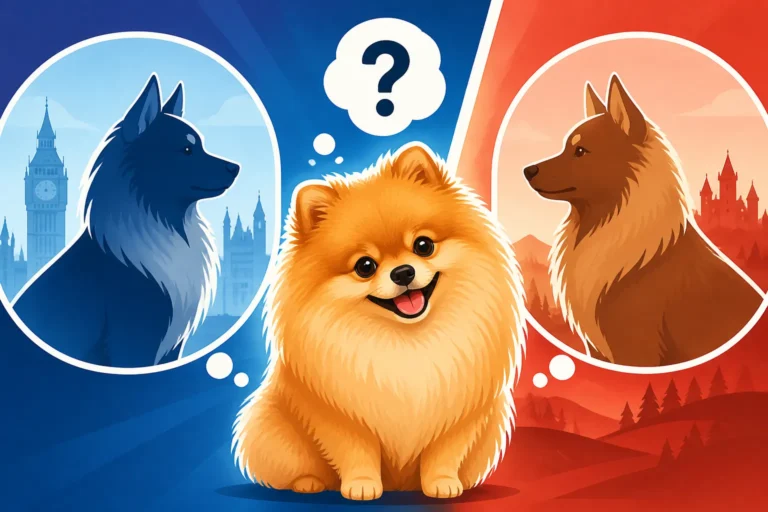
If someone asks whether a Pomeranian is related to a Norwegian Elkhound, a balanced answer is: they are both Spitz-type dogs and may share distant northern dog ancestry, but the Pomeranian is not generally understood as a direct descendant of the Norwegian Elkhound. The Pomeranian is associated with the German Spitz family and the historical Pomerania region, while the Elkhound is a Norwegian hunting breed.
This answer avoids two common extremes. One is claiming that the breeds have no relationship whatsoever because they look and live so differently. The other is treating a shared appearance as proof that one breed directly descended from the other. The evidence supports a broad family resemblance more comfortably than a narrow, specific ancestor claim.
When reading breed histories, look for the difference between words such as “related,” “descended from,” and “resembles.” “Related” can describe a broad family connection. “Descended from” implies a more direct lineage. “Resembles” describes appearance, without necessarily making a claim about ancestry. Keeping those meanings separate makes breed history easier to evaluate.
What the connection means for owners
For a Pomeranian owner, the Elkhound connection is mostly a helpful way to understand the breed’s northern-looking features. It does not mean that a Pomeranian needs the same exercise, training, or work as an Elkhound. A Pomeranian is still an individual toy companion with its own body size, care needs, and temperament.
Likewise, shared coat type does not mean the breeds need identical grooming routines. Pomeranians have a dense double coat that needs regular attention, especially to prevent tangles and mats. If you are exploring the Pomeranian’s coat and how it works, The Double Coat That Makes a Pomeranian and Why It Stays On is a useful next read. The breed’s physical appearance may echo other Spitz dogs, but its daily care should be based on the Pomeranian in front of you.
A Pomeranian’s history also should not be used to infer that it is a miniature working Elkhound. Breed ancestry can illuminate where certain features came from, but it does not predict every dog’s personality or needs. For a broader account of how the breed’s size changed, see How the Pomeranian Halved in Size in One Lifetime. The most accurate picture is both simple and nuanced: the breeds share a broad Spitz identity, while their modern histories and purposes are distinct.
Disclaimer
This article is for general informational purposes only and does not constitute professional advice. Laws, prices and regulations vary by location and change over time. Consult a qualified professional for guidance on your specific situation.