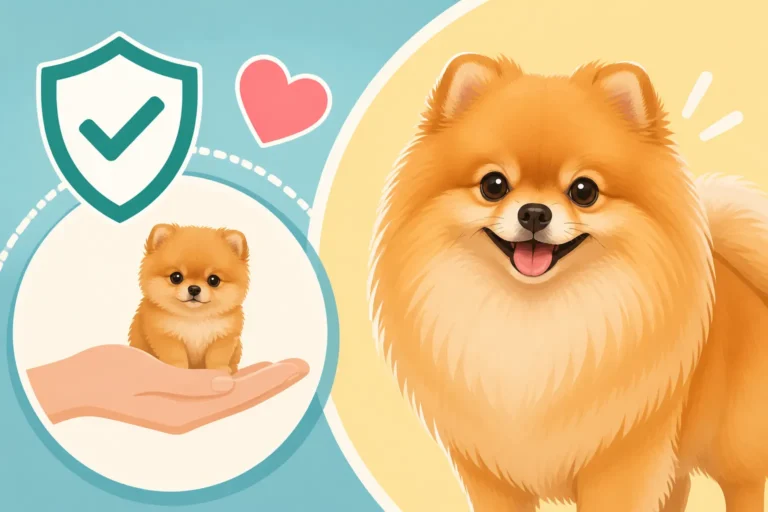
Whether a Teacup Pomeranian Is a Different Type
A tiny Pomeranian can look so different from the dog described in breed guides that it is easy to wonder whether “teacup” means a separate kind of Pom. It does not. This guide explains what the label means, how it differs from breed standards, why extreme smallness deserves careful thought, and what to check before bringing a very small Pomeranian home.
Is a Teacup Pomeranian a Different Type
“Teacup” is a marketing label, not a separate breed
A teacup Pomeranian is still a Pomeranian. “Teacup” is an informal term used to describe a particularly small dog; it is not a distinct breed or an officially recognized Pomeranian variety. A seller may also use terms such as “micro,” “toy,” or “tiny,” but those labels do not create a separate category with its own accepted pedigree or health standard.
That distinction matters because the word can sound like a meaningful classification. Buyers may assume a “teacup” puppy has been bred according to special, reliable guidelines. In practice, the label alone tells you little about the puppy’s parents, adult size, health screening, or breeding conditions. Two sellers can use the same word for dogs with very different backgrounds.
If you are trying to understand where the label fits, Whether Teacup Is a Real Pomeranian Category discusses the terminology directly. It is also useful to compare the label with The Three to Seven Pounds a Pomeranian Is Allowed, which explains the breed-standard context. Standards can differ between kennel organizations, but “teacup” is not a formal size class in the way an official breed standard is.
Small size does not make a dog a different Pomeranian type
Pomeranians naturally vary in size. Some adults are smaller than others, and a dog that is simply petite is not automatically unhealthy or less of a Pomeranian. The key question is not whether a dog is small. It is how that size came about and whether the dog can live comfortably and safely.
A healthy, naturally small Pomeranian is different from a puppy deliberately bred toward extreme tininess without enough attention to sound structure or health. A tiny puppy may also be too young for anyone to make a dependable prediction about its adult size. A seller’s estimate—or a label such as “teacup”—cannot guarantee that a growing puppy will stay within a particular weight range.
If the main appeal is a dog that is easy to carry, remember that small size does not always mean easier care. A very tiny Pom can require extra attention around furniture, stairs, children, larger dogs, meals, and outdoor hazards. A standard-sized Pomeranian is also already a small companion dog, so it is worth asking what you hope the smaller size will make easier.
What the Teacup Label Can Hide
Adult size is hard to promise when a puppy is still growing
Puppy size can be difficult to forecast with certainty. Parents’ size may offer context, but it does not provide a guarantee. Growth can also be affected by health, nutrition, and the puppy’s individual development. Be cautious when a seller promises that a young puppy will weigh a precise amount as an adult, especially if the promise is based mainly on the puppy’s current weight or the size of its paws.
Ask for the puppy’s age, current weight, growth history, and the adult weights of both parents. Request veterinary records and ask whether a veterinarian has examined the puppy. A responsible seller should be willing to discuss uncertainty rather than present a sales label as a medical prediction.
A useful distinction is whether the puppy is simply small for its age or is being marketed as unusually tiny because buyers are willing to pay more for that description. How Small a Pomeranian Can Safely Be Bred looks at the concern around deliberately breeding for extreme size. And Whether a Teacup Pomeranian Is Structurally Sound is a helpful topic to consider when assessing whether a dog’s build—not just its weight—appears robust and comfortable.
Breeding for the smallest possible size can bring added risks
Very small dogs may be more vulnerable to everyday accidents. A fall from a sofa, a door closing unexpectedly, or a child picking a puppy up awkwardly can cause serious injury. Tiny puppies may also have less reserve when they are unwell or not eating, so changes in appetite, energy, or coordination deserve prompt attention from a veterinarian.
Small size alone does not prove that a particular Pomeranian has a health problem. Still, breeding choices that prioritize extreme tininess over health and sound structure can raise reasonable concerns. Depending on the individual dog, issues to discuss with a veterinarian may include fragile bones, dental crowding, kneecap problems, breathing or windpipe concerns, and low blood sugar in very young or exceptionally small puppies. A seller should not dismiss those questions by saying the puppy is “just a teacup.”
The risks are not only about the puppy’s first weeks at home. A dog that is exceptionally small may need lifelong management around jumping, play with larger animals, feeding routines, and safe handling. The Health Cost of Breeding Pomeranians Under Three Pounds explores why size-focused breeding deserves scrutiny, while Whether a Two Pound Pomeranian Can Be Healthy addresses the fact that a number on the scale is not, by itself, a full health assessment.
| What you hear or see | What it may mean | A sensible next step |
|---|---|---|
| “Teacup” or “micro” in an advertisement | An informal sales description, not proof of a separate type | Ask about the puppy’s parents, age, health records, and growth |
| A precise adult-weight promise | A prediction, not a guarantee | Ask how the estimate was made and what uncertainty remains |
| Pressure to pay quickly or send a deposit immediately | The seller may be discouraging careful checks | Slow down and verify the seller, puppy, and paperwork |
| No opportunity to discuss health or see records | Important details may be missing | Request veterinary documentation and clear answers before deciding |
| A puppy described as tiny but weak, unusually sleepy, or reluctant to eat | Potential health concerns that should not be explained away by size | Seek prompt veterinary assessment |
How to Assess a Very Small Pomeranian
Look beyond the advertised label
Start by asking to see reliable information about the puppy’s parents and the conditions in which the litter was raised. Ask whether you can meet the mother, or receive a clear explanation if that is not possible. Request the puppy’s veterinary records, vaccination and parasite-control history, and any available screening information for the parents. A seller should answer questions without making you feel unreasonable for asking.
Be wary of listings that lean heavily on phrases such as “rare teacup,” “pocket-sized,” or “will fit in a cup” while offering little detail about health or temperament. A dramatic size claim is not a substitute for a veterinarian’s assessment. Nor is a registration document, by itself, proof that the puppy is healthy or that a particular size label is meaningful.
The Papers a Pomeranian Breeder Should Provide can help you think through the records and documentation to request. For broader context about the potential consequences of size-first breeding, see What Teacup Breeding Costs a Pomeranian. A careful buyer is not being fussy; they are trying to understand what the puppy may need and whether the seller has put health first.
Ask practical questions before making a decision
A good conversation with a breeder or rescue should cover the puppy’s routine and the support available after adoption. Ask what the puppy eats, how often it is fed, how it responds to handling, and what veterinary care it has received. If the puppy is exceptionally small, ask whether the veterinarian has discussed feeding frequency, safe exercise, or any specific monitoring needs.
Pay attention to how the seller responds. Clear, calm answers are reassuring. Vague statements, pressure to decide immediately, or claims that a tiny puppy will never have health problems are reasons to pause. No breeder can responsibly promise a lifetime without illness, and a responsible person should not discourage you from consulting your own veterinarian.
It is also reasonable to ask what happens if a health concern appears soon after the puppy comes home. Get any health guarantee, return policy, or contract terms in writing, and read them before you pay. If you are considering adoption, ask the rescue what is known about the dog’s medical history and what support it offers if records are incomplete.
Caring for a Very Small Pom at Home
Make the home safer before the puppy arrives
A very small dog can be injured by hazards that seem ordinary in a larger household. Block access to high furniture or supervise closely when the dog is near it. Use a stable ramp or steps where appropriate, but teach the puppy to use them gradually and do not assume a tiny dog can safely jump down. Keep play with bigger dogs calm and supervised, and give the Pomeranian a protected space where it can rest undisturbed.
Children should be shown how to sit on the floor and let the puppy approach rather than carrying it around. Even a gentle child can accidentally drop a wriggling puppy or squeeze too tightly. Keep doors, recliners, and other moving household items in mind; a dog that is difficult to see underfoot can be at risk in a busy room.
If you are shopping for a suitably small harness, carrier, or home-safety supplies, Chewy is one place owners may browse to compare product sizes. Check measurements carefully and make sure equipment fits without restricting movement or putting pressure on the throat. A product sold as “small” is not necessarily sized for a very petite Pomeranian.
Keep care routines steady and get veterinary guidance
Follow the feeding plan recommended by the puppy’s veterinarian, particularly if the dog is exceptionally small or very young. Do not make a sudden food change or assume a tiny puppy can simply skip a meal. If the dog becomes weak, shaky, unusually sleepy, confused, or unsteady, contact a veterinarian promptly rather than trying to diagnose the cause at home.
Routine preventive care still matters: veterinary checkups, dental care, coat maintenance, safe exercise, and keeping the dog at a healthy weight. Very small dogs can have crowded mouths, and a thick coat may make it harder to judge body condition by sight alone. A vet can help you set sensible expectations for the individual dog instead of relying on a seller’s size claim.
Chewy may also be useful for comparing small-sized grooming tools or food-storage supplies, but choose based on your veterinarian’s advice and the dog’s actual needs—not simply because a package uses the word “teacup.” If you want a carrier for travel, check that the dog can rest comfortably and that the carrier is secure and well ventilated. Chewy listings and other retailer descriptions are starting points for comparison; fit and safe use matter more than the label.
Deciding Whether a Teacup Pomeranian Is Right for You
Focus on the individual dog, not the promise of tininess
It is understandable to be drawn to a very small Pomeranian. They can look delicate and appealing, and some people assume a smaller dog will suit an apartment, travel easily, or need less exercise. But a teacup label does not guarantee any of those things. A very small dog may need more supervision, careful handling, and thoughtful planning than a sturdier Pom.
Think about your household honestly. Are there young children, energetic larger pets, or frequent visitors who may not notice a tiny dog underfoot? Are you comfortable managing a puppy that needs a consistent feeding routine and protection from falls? Can you arrange prompt veterinary care if something changes? Those questions are more useful than asking whether the dog will stay below a particular weight.
If your goal is simply a small companion, consider whether a Pomeranian of typical, sound size may be a better fit than one marketed as exceptionally tiny. A responsible breeder or rescue should help you weigh temperament, health, and lifestyle—not just the appeal of a size label.
Take time to verify before you commit
Before bringing a puppy home, review the paperwork, speak with a veterinarian, and make sure the seller or rescue answers your questions openly. Do not let urgency or a claim that a puppy is “the last teacup available” replace careful checks. If something feels unclear, it is reasonable to step back and ask for more information.
The bottom line is straightforward: “teacup Pomeranian” describes a sales label, not a different Pomeranian type. A naturally small Pom may be a healthy individual, but extreme smallness and size-focused breeding deserve careful scrutiny. Choose based on the puppy’s health, structure, temperament, background, and the care you can provide—not on a promise that it will remain tiny.
Disclaimer
This article is for general informational purposes only and does not constitute professional advice. Laws, prices and regulations vary by location and change over time. Consult a qualified professional for guidance on your specific situation.