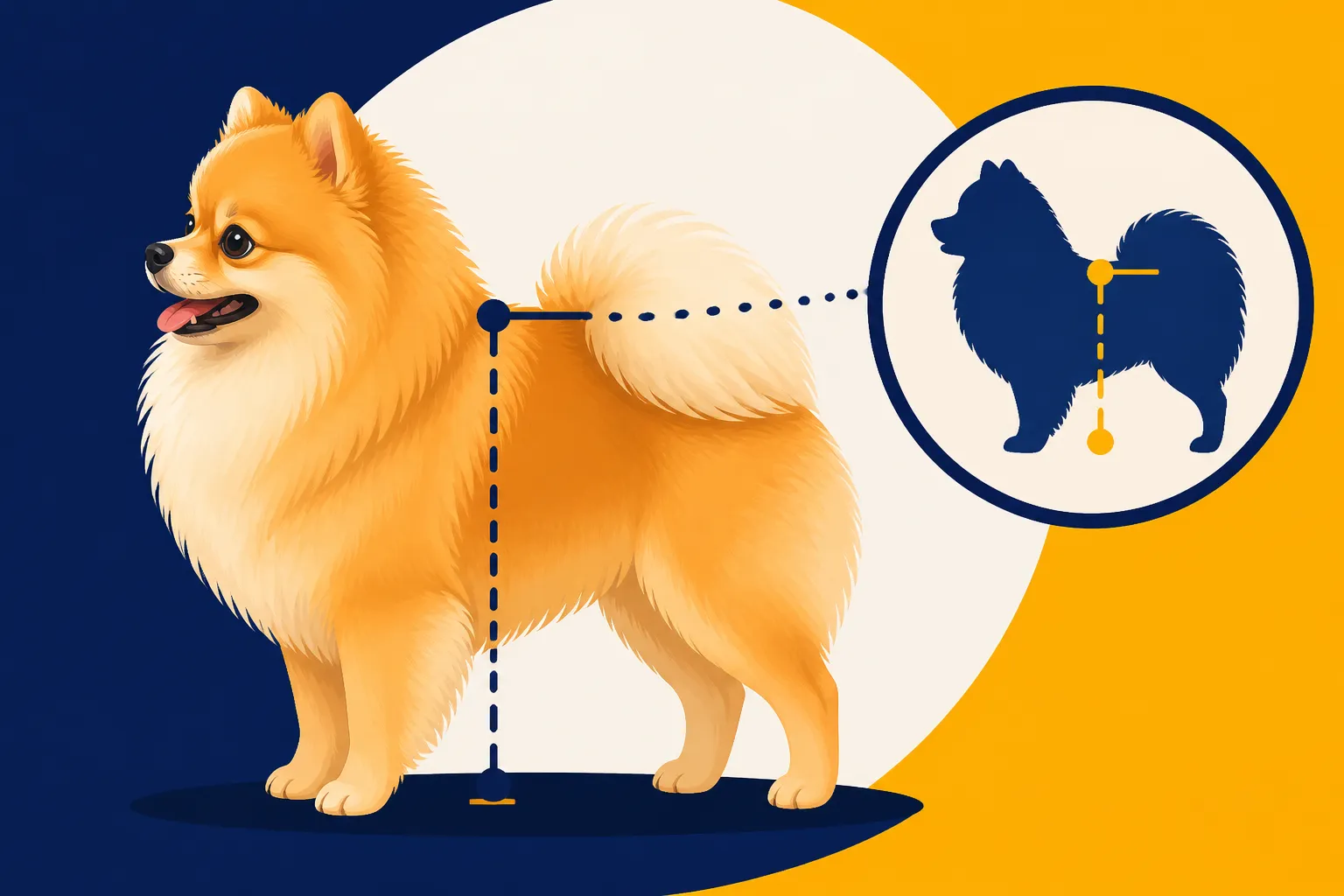
The Inches at the Withers a Pomeranian Is Judged On
It's completely normal to feel a bit overwhelmed when you start delving into the specific measurements and standards of a purebred dog, especially when terms like "height at the withers" get tossed around. Many of us just want to know our fluffy companions are healthy and happy, and the idea of them being "judged" on a precise number can feel quite alien. This guide is here to shed light on exactly what the height at the withers means for a Pomeranian, why it's a critical factor in their breed standard, and how it impacts everything from their appearance to their overall well-being, whether they're destined for the show ring or simply your sofa.
Understanding the Pomeranian Breed Standard for Size
The breed standard for any purebred dog is essentially the blueprint that guides breeders and judges in maintaining the unique characteristics of that particular breed. For Pomeranians, this standard outlines everything from their distinctive double coat and foxy expression to their compact size and lively temperament. When it comes to size, the "height at the withers" isn't just a random measurement; it's a carefully considered detail that speaks volumes about a dog's adherence to its heritage and often, its structural soundness. It’s about ensuring that each generation of Pomeranians truly embodies the essence of the breed.
This standard isn't about creating uniformity for uniformity's sake, but rather about preserving the traits that define a Pomeranian. It's a testament to the history of the breed, tracing back to larger Spitz dogs and the careful selection that led to the miniature companions we adore today. Understanding this foundation helps us appreciate why specific measurements, like height, play such a crucial role in the world of purebred dogs.
Defining "At the Withers": More Than Just a Measurement
Let's demystify "at the withers" right away. When you hear this term, it refers to the highest point of your dog's shoulder blades, where the neck transitions into the back. It’s not the top of their head, which can vary with how they hold their neck, nor is it the tip of their fluffy, curled tail. Imagine a perfectly straight line drawn vertically from the floor up to this point on their back—that's the measurement a judge is interested in. This consistent reference point ensures fairness and accuracy when assessing a dog's height, regardless of its posture or coat fluff.
For a Pomeranian, this measurement is typically taken with the dog standing squarely on a level surface, with its head in a natural, alert position. A judge will typically use a wicket, a specialized measuring device, to get this precise reading in the show ring. The exactness of this measurement is paramount because even a slight deviation can change the overall impression of balance and proportion, which are key components of the breed standard. It's a precise detail that contributes to the overall picture of the compact, elegant Pomeranian.
Why the Breed Standard for Size Exists
You might be thinking, "My Pomeranian is perfect no matter how tall they are!" And you'd be absolutely right for a beloved family pet. However, for the serious breeders and enthusiasts involved in maintaining and advancing the breed, the size standard serves several vital purposes. Primarily, it's about preserving the distinct "Pomeranian type." Without a clear standard, the breed could gradually drift, leading to dogs that no longer resemble the classic Pomeranian in size, shape, or proportion. This adherence to type is what maintains their unique identity in the vast world of dog breeds, a legacy from How the Pomeranian Halved in Size in One Lifetime.
Beyond aesthetics, the size standard often correlates directly with health and function. Over generations, breeders have found that a certain size range tends to be the healthiest and most structurally sound for the breed, minimizing predispositions to certain ailments. For instance, extreme miniaturization, often pursued outside of the standard, can lead to a host of fragility issues. The standard provides a guideline for what is considered a robust and healthy size for a toy breed, ensuring the dogs can live full, active lives without being overly delicate. It's a balance of form and function, designed to protect the breed's future.
The Ideal Height Range and Its Implications
Every breed standard has its "sweet spot," and for the Pomeranian, this includes a very specific height range at the withers. This isn't just a guideline; it's a defining characteristic that sets the breed apart within the toy group. Being within this range suggests not only aesthetic correctness but also an underlying structural soundness that allows a Pomeranian to move and carry itself with the characteristic confidence and agility for which it is known.
Understanding these ideal measurements helps prospective owners and breeders make informed decisions, whether they're aiming for the show ring or simply seeking a healthy, well-adjusted pet. It’s a crucial aspect that shapes expectations and helps identify dogs that truly conform to the breed's established heritage.
The Golden Numbers: Official Height Requirements
The official breed standard for the Pomeranian typically states that the ideal height at the withers should be between 6 to 7 inches. This is a fairly narrow range, emphasizing the breed's small, compact stature. Within this range, judges are often looking for dogs that exude a sense of balance and substance appropriate for their size. A Pomeranian standing exactly 6.5 inches, for example, might be considered a prime example, striking that perfect chord of daintiness without fragility. This precise measurement helps to distinguish the Pomeranian from slightly larger Spitz-type breeds and ensures they maintain their cherished toy dog status.
It’s important to note that while weight is often discussed, the height at the withers is the primary numerical measurement cited in most breed standards for the Pomeranian. Weight is usually described in terms of what is proportionate to the height and overall build, rather than a hard number. This focus on height underscores its foundational role in the breed's overall structure and presentation. This is the essence of The Six to Seven Inches a Pomeranian Measures.
The Impact of Being Too Small: When Tiny Becomes a Problem
While the allure of an incredibly tiny "teacup" Pomeranian can be strong for some, the breed standard generally penalizes, and sometimes disqualifies, dogs that fall significantly below the 6-inch mark. A Pomeranian measuring, say, 5 inches or less at the withers, might seem adorable, but this extreme smallness often comes with considerable health risks that reputable breeders actively try to avoid. It’s a deviation that often puts fragility over function.
These significantly undersized Poms are frequently more susceptible to a range of health issues. They can struggle with episodes of Blood Sugar Crashes in a Pomeranian Puppy due to their inability to efficiently store glucose. Their bones are much more delicate, making them prone to fractures from even minor tumbles or jumps off furniture. Furthermore, they may have persistent open fontanelles (soft spots on their skull), leaving their brain less protected. The discussions around What Teacup Breeding Costs a Pomeranian highlight these serious concerns, emphasizing that chasing extreme miniaturization can inadvertently lead to a much more vulnerable and less healthy companion. Even routine procedures, as explored in Anesthesia Risk in a Four Pound Pomeranian, carry heightened risks for these very small individuals.
The Impact of Being Too Large: Losing the Toy Dog Essence
On the opposite end of the spectrum, Pomeranians that grow to be significantly larger than the standard's 7-inch maximum are also typically penalized in the show ring. While not as prone to the same extreme fragility as their tiny counterparts, an oversized Pomeranian might measure 8, 9, or even 10 inches at the withers. These dogs are sometimes referred to as "throwbacks" to the breed's larger ancestors. They might be perfectly healthy and robust, but they often lose the distinctive delicate and compact appearance that defines the Pomeranian in the toy group.
A larger Pomeranian might still possess the beautiful double coat and foxy face, but its overall proportions can appear heavier, longer-backed, or less refined than the standard dictates. This shift in proportion can affect their gait and overall movement, making them appear less sprightly or agile. While a Pomeranian may still be purebred, a Whether a Twelve Pound Pomeranian Is Purebred would likely not be competitive in conformation events because it strays too far from the established ideal for its size. These larger Poms make wonderful, sturdy companions, but for those interested in the show ring, adherence to the size standard is paramount.
How Height Influences a Pomeranian's Overall Appearance and Movement
The height at the withers is far more than just a number; it’s a pivotal element that profoundly dictates a Pomeranian's overall aesthetic and physical capabilities. A Pomeranian's beauty lies in its balanced proportions, and any significant deviation in height can disrupt this harmony, affecting how the dog carries itself and moves. The breed standard paints a picture of a dog that is small, yes, but also sturdy and well-put-together, and height is the cornerstone of that visual.
When a judge looks at a Pomeranian, they are assessing a whole picture, a cohesive package. The height contributes immensely to this initial impression, setting the stage for how all other features, from the extravagant coat to the perky ears, fall into place. Without correct height, the entire "look" can be altered, diminishing the quintessential Pomeranian charm.
Proportion and Balance: The Key to a Classic Look
In the world of purebred dogs, proportion and balance are akin to the symmetry in a piece of fine sculpture—every part works together to create a pleasing and functional whole. For a Pomeranian, the ideal height at the withers contributes directly to its desired "square" appearance. This means that the length of the dog's body, measured from the point of its shoulder to the point of its buttock, should be approximately equal to its height at the withers. A dog that is too tall for its body length might look leggy or rangy, losing that desirable compact, sturdy, and well-knit appearance. Conversely, a dog that is too short can appear long-backed or cobby.
This harmonious proportion isn't merely for show; it's also crucial for the dog's overall physical soundness and agility. A well-proportioned Pomeranian moves more efficiently and is generally less prone to certain structural imbalances that could lead to discomfort or injury over time. Even the magnificent The Ruff a Pomeranian Should Carry and its high-set, plumed tail, though visually dominant, are enhanced by a correctly proportioned body underneath. A dog with ideal height appears to have its fluffy coat sitting just right, giving it that rounded, confident silhouette.
Movement and Soundness: A Flowing, Effortless Gait
A true Pomeranian should exhibit a gait that is smooth, free, and purposeful, reflecting its intelligent and active nature. The correct height at the withers plays a significant role in facilitating this ideal movement. When a dog is structurally balanced in terms of its height and length, its legs can swing freely and cover ground efficiently without wasted effort. A Pomeranian that is too tall might exhibit a more ungainly or wide gait, appearing to overreach or lack the brisk, light step characteristic of the breed. Similarly, a dog that is too short might appear to waddle or struggle to move with the desired fluidity.
Judges in the conformation ring meticulously observe a dog's movement from all angles—front, rear, and side—looking for any signs of lameness, stiffness, or awkwardness. They want to see a lively, floating action, a reflection of good health and proper angulation. While issues like Slipping Kneecaps in a Five Pound Pomeranian can certainly impair a dog’s gait, even a dog free of such conditions might fail to demonstrate the breed's characteristic "pizzazz" in its step if its height and proportions are off. The correct height ensures that the Pomeranian can move with the energy and self-assurance that is part of its charm.
The Nuances of Judging Pomeranian Size
For those new to the world of dog shows, the judging process can seem a bit mysterious. When it comes to assessing a Pomeranian's size, it's far more intricate than simply pulling out a tape measure. Judges are highly trained and experienced individuals who evaluate a multitude of traits simultaneously, and size, while important, is integrated into a comprehensive assessment that ultimately determines a dog's adherence to the breed standard.
This holistic approach means that even a dog with perfect height might not win if other aspects, such as temperament, coat, or movement, are lacking. It underscores the complexity and skill involved in evaluating show dogs, where the sum of all parts creates the desired picture of breed perfection.
The Judge's Eye: Beyond the Measuring Tape
While the breed standard explicitly states the ideal height range, it's quite rare for a judge to physically measure a Pomeranian in the ring unless there is a very obvious or extreme deviation from the standard that warrants an official confirmation. Instead, judges rely heavily on their highly developed "eye"—an instinct and understanding cultivated over years of studying the breed standard, handling countless dogs, and observing top examples of the breed. They can quickly assess the overall balance and proportion, and instinctively know when a dog "fits" the size requirement.
A judge will observe the Pomeranian as it stands stacked, as it gaits around the ring, and during a hands-on examination. They are not just looking at a number; they are evaluating how that height contributes to the dog's overall picture of breed type, including its substance, bone, and how well it carries its coat. The dog's temperament, health, and the quality of its magnificent double coat are all part of this overall impression. It’s a dynamic, moment-by-moment assessment, where the ideal height underpins the visual harmony of the dog.
Disqualifications and Penalties Related to Size
The breed standard also outlines specific penalties and outright disqualifications for size deviations. While a Pomeranian that is marginally outside the ideal 6 to 7-inch range might simply incur a "fault" (a deduction of points), extreme deviations can lead to an outright disqualification, meaning the dog cannot win any awards in the show ring. For instance, some standards may state that a dog significantly undersized or oversized is to be disqualified, preventing very atypical examples from influencing future breeding decisions within the competitive show lines.
This strict enforcement of size is crucial for maintaining the breed's integrity and preventing the propagation of traits that deviate too far from the established ideal. For breeders, understanding these rules is paramount, as a dog with an otherwise flawless pedigree and conformation might still be unable to compete if it falls outside the acceptable size parameters. This is part of the reason a show quality Pomeranian costs more, as these dogs must meet a very stringent set of criteria. For pet owners, however, these disqualifications are largely irrelevant; a dog that is too tall or too short to be a show champion can still be a perfect, loving companion.
Health Implications of Size Deviations
While the breed standard provides a benchmark for aesthetic conformity, it also implicitly promotes health and well-being. The specified height range isn't arbitrary; it reflects a size that has historically proven to be robust and healthy for the Pomeranian. When dogs fall outside this range, particularly towards the extremes, the potential for health complications can unfortunately increase, impacting their quality of life.
This section highlights why a breeder committed to the standard is also often committed to the health of their lines. Extreme size, whether too small or too large, can often be a warning sign of underlying vulnerabilities that responsible breeding aims to minimize.
The Risks of Tiny Pomeranians: Fragility and Vulnerability
The intense demand for "teacup" or "micro" Pomeranians has led to some breeders intentionally breeding for sizes significantly below the standard 6-inch minimum. While these tiny dogs can be incredibly appealing due to their miniature stature, this extreme smallness often comes at a steep price in terms of health and longevity. These ultra-small Poms are often much more fragile and prone to a range of serious medical conditions. One of the most common and dangerous issues is Blood Sugar Crashes in a Pomeranian Puppy, or hypoglycemia, where their tiny bodies struggle to maintain stable blood glucose levels, leading to lethargy, seizures, or even death if not promptly treated. Their digestive systems can also be particularly delicate, making them prone to tummy upsets and difficulty absorbing nutrients.
Beyond metabolic issues, their skeletal structure is incredibly fragile. Their bones are thinner and more brittle, increasing their risk of fractures from everyday activities like jumping off a chair or even being accidentally stepped on. Many also suffer from unclosed fontanelles, which are soft spots on their skull where the bone hasn't fused, leaving their brains vulnerable. The article Whether a Teacup Pomeranian Is Structurally Sound delves deeper into these concerns, illustrating that while adorable, extreme miniaturization often compromises a dog’s overall robustness and capacity for a long, healthy life. These health risks can lead to frequent veterinary visits and significant care requirements, which Chewy offers a variety of specialized small breed foods and supplements to help manage.
The Challenges of Oversized Pomeranians: Less Common, But Still Relevant
While the health risks associated with undersized Pomeranians receive more attention, those significantly larger than the standard can also present unique considerations, though often less severe. A Pomeranian that naturally grows to 9-10 inches at the withers and perhaps weighs 10-12 pounds is often referred to as a "throwback." These dogs are usually robust and healthy, resembling the breed's larger ancestors. However, their increased size and weight can introduce different types of concerns compared to their smaller counterparts.
For instance, while generally sturdy, a larger Pomeranian might place slightly more strain on its joints, making conditions like Slipping Kneecaps in a Five Pound Pomeranian something to monitor, even if the risk is not as pronounced as in giant breeds. Maintaining a healthy weight becomes even more critical for these larger Poms to avoid undue stress on their skeletal system as they age. Although not typically prone to the same fragility as teacups, their sheer size might affect certain breed-specific ailments, such as tracheal collapse, where extra weight can exacerbate symptoms. Nonetheless, these larger, healthy Poms are frequently cherished family members who often enjoy long, active lives, proving that deviations from the show standard don't necessarily preclude a happy and healthy existence as a pet.
Living with a Pomeranian Outside the Standard
It's easy to get caught up in the exacting specifics of breed standards, especially when you're deeply invested in finding or owning a purebred dog. However, for the vast majority of Pomeranian enthusiasts, the ultimate goal is not to win ribbons in the show ring, but to share their lives with a beloved, healthy, and happy companion. Whether your fluffy friend measures precisely 6.5 inches at the withers or falls a bit outside that golden range, their worth as a family member remains immeasurable.
This section aims to bring perspective, reminding us that while standards serve a vital purpose in breed preservation, the real joy of Pomeranian ownership comes from their unique personalities and the unconditional love they offer, regardless of their conformity to an inch-perfect ideal.
Pet Poms vs. Show Poms: Different Priorities, Equal Love
For most of us, our Pomeranians are undeniably family members first and foremost. The "perfect" pet Pomeranian is defined not by how precisely they measure at the withers, but by their vibrant personality, their boundless affection, and the sheer joy they bring into our homes. Whether your Pom is 5 inches or 8 inches tall, if they are healthy, well-adjusted, and showered with love, they are absolutely ideal. A "pet quality" Pomeranian is simply a dog that might have a minor deviation from the breed standard—perhaps a slightly longer back than desired, ears that are a tad too large, or a height that falls just outside the ideal range. These are typically aesthetic differences that have no bearing whatsoever on their ability to be a fantastic, loving companion.
Reputable breeders are transparent about whether a puppy is considered "show quality" or "pet quality." Often, pet quality puppies are offered at a more accessible price point and come with limited registration papers, meaning they are sold purely as companions and cannot be shown in conformation or used for breeding. This practice helps ensure that only the best examples contribute to the next generation while still providing wonderful, healthy dogs to loving homes. Your priority as a pet owner should always be a healthy, well-socialized pup, whose individual quirks and personality will win your heart, regardless of their show ring potential.
Finding a Healthy Companion: Focusing on Well-being Over Strict Adherence
When you're searching for a Pomeranian puppy, instead of fixating solely on an exact height measurement, it’s far more beneficial to focus on the overall health, temperament, and ethical breeding practices. Look for breeders who are committed to health testing the parent dogs for common Pomeranian health issues, such as luxating patellas, tracheal problems, and any cardiac concerns. These health clearances provide a much stronger indication of a long, healthy life for your future companion than any specific measurement might.
A responsible breeder will openly discuss the health history of their lines, provide a health guarantee, and be transparent about any potential issues in the litter. Ask to meet the puppy's parents, observe the puppies' energy levels, and see how they interact with their littermates and humans. Inquire about their feeding schedule, as Feeding a Pomeranian Puppy Often Enough to Stay Safe is crucial for their rapid growth and preventing blood sugar issues. Resources like Chewy offer not only a wide array of specialized small breed puppy foods but also valuable articles and advice on puppy care and health. Ultimately, a Pomeranian of any reasonable size, given excellent care, proper nutrition, and plenty of love, will undoubtedly enrich your life and become a cherished family member for many wonderful years.
| Category | Height at Withers (Approx.) | Show Ring Status | Common Health Considerations | Pet Owner Perspective |
|---|---|---|---|---|
| Ideal Standard | 6 – 7 inches | Highly Desirable | Generally robust if well-bred, fewer breed-specific risks | Excellent health potential, may be higher cost |
| Undersized | Below 6 inches | Penalized/Disqualified | Hypoglycemia, fragile bones, open fontanelles, temperature regulation issues | Potentially higher vet bills, requires very careful handling |
| Oversized | Above 7 inches | Penalized | Generally healthy, slight joint strain risk, potential for obesity issues | Often very sturdy, can live long healthy lives, may be less costly |
Disclaimer
This article is for general informational purposes only and does not constitute professional advice. Laws, prices and regulations vary by location and change over time. Consult a qualified professional for guidance on your specific situation.