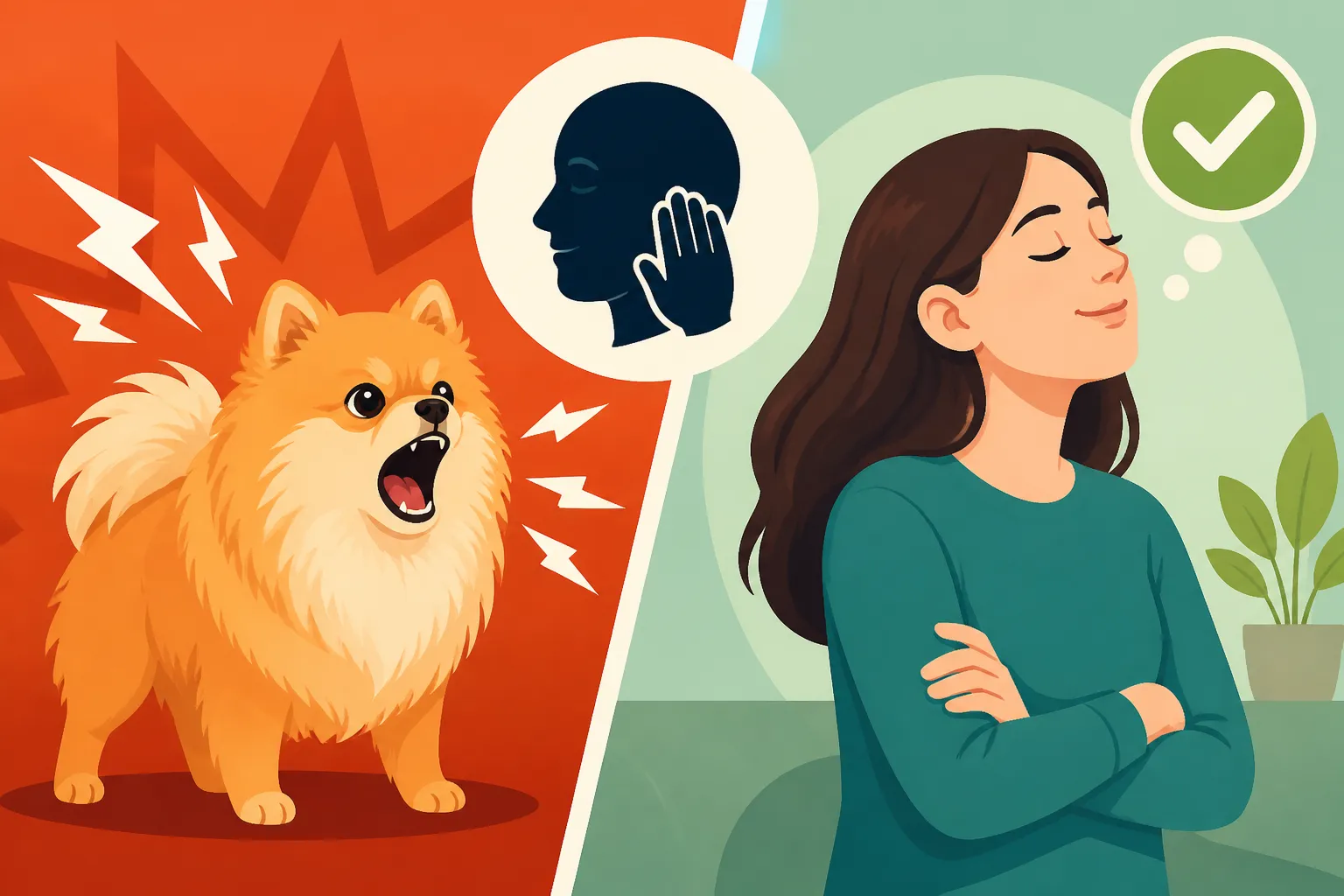
Whether Ignoring a Pomeranian’s Barking Works
The incessant yapping of a Pomeranian can feel like a tiny, furry siren, piercing through your peace and quiet. Many owners find themselves at their wit's end, wondering if they're doing something wrong or if their little fluffball is just wired to be a vocal guardian. This guide will delve deep into the effectiveness of ignoring your Pomeranian's barking, exploring when this strategy might actually work, when it's utterly unhelpful, and comprehensive alternatives to help you reclaim your quiet home.
Why Pomeranians Bark So Much in the First Place
Before we even consider ignoring the barking, it's crucial to understand why your Pomeranian is sounding the alarm. These aren't just random outbursts; there's always a reason, even if it's not immediately obvious to us. Pomeranians, with their Spitz heritage, were originally bred to be alert dogs. They're naturally watchful, intelligent, and possess a strong desire to communicate, often through vocalization. This inherent trait, combined with modern living, can lead to a symphony of barks.
Alert Barking and Territorial Instincts
One of the most common reasons a Pomeranian barks is to alert you to something new or perceived as a threat. That leaf skittering across the driveway? A potential intruder. The mail carrier daring to approach the front door? A grave danger that must be announced. This is their deep-seated territorial instinct kicking in. They see themselves as pint-sized protectors of their home and their people. They truly believe they are doing their job by letting you know every single thing that happens within their perceived territory. This isn't naughtiness; it's instinct. It can be exhausting for us, but for them, it's serious business. We've all been there, wondering if The Doorbell and the Pomeranian Response will ever be calm.
Attention-Seeking and Learned Behavior
Pomeranians are incredibly smart and quick to learn what gets your attention. If they bark, and you immediately look at them, talk to them, or even scold them, they've successfully achieved their goal: your focus. Even negative attention is still attention, and for a social creature like a Pomeranian, that can be a powerful motivator. They learn that "barking = human response." This becomes a self-reinforcing cycle. You might even find yourself reaching for a treat to quiet them down, inadvertently teaching them that barking pays off. They’re not being manipulative; they’re just being efficient in getting what they want from their environment.
Anxiety, Boredom, and Frustration
Sometimes, barking isn't about protecting or seeking attention, but rather a manifestation of internal discomfort. A Pomeranian left alone for long periods without sufficient mental or physical stimulation might bark out of sheer boredom or frustration. Imagine being trapped in a small space with nothing to do – you'd probably make some noise too! Separation anxiety is another huge trigger for barking, where the dog panics when separated from their owner. This isn't something they can easily control. Similarly, a Pomeranian who is feeling anxious or unsure about a new person or situation might resort to barking as a coping mechanism. It’s their way of saying, "I'm scared!" or "I don't know what to do!" Understanding Whether a Pomeranian Barks From Fear or Habit is key to addressing this.
The "Ignoring" Strategy: When It Works and When It Falls Flat
The idea of ignoring your Pomeranian's barking is often suggested as a primary solution, and it can be effective in specific situations. The core principle is based on extinction: if a behavior no longer produces the desired outcome (e.g., your attention), it should eventually cease. However, it's far from a universal fix and comes with its own set of challenges.
Understanding Extinction Bursts
When you first start ignoring a behavior that has previously been reinforced, you won't see an immediate decrease. In fact, you'll almost certainly see an increase in the behavior. This is known as an "extinction burst." Your Pomeranian, accustomed to getting a reaction, will try harder and bark more intensely to get you to respond. They'll think, "My usual bark isn't working, I need to try louder! Longer!" This stage can be incredibly frustrating and test your patience. Many owners give up during an extinction burst, accidentally teaching their dog that if they just bark enough, they'll eventually get what they want. It’s like hitting a button repeatedly when it doesn’t work, hoping it suddenly will.
| Barking Trigger | Type of Barking | Is Ignoring Likely to Work? | Primary Action Besides Ignoring |
|---|---|---|---|
| Doorbell/Mail Carrier | Alert/Territorial | Rarely effective alone | Management, desensitization, "quiet" command |
| Owner Leaving Room | Attention-seeking | Potentially, with consistency | Redirection, reward quiet, gradual distance training |
| Boredom/Lack of Play | Frustration/Attention | No, need engagement | Enrichment, exercise, puzzle toys |
| Strange Noise Outdoors | Alert | Unlikely, deeply ingrained | Management (block view), desensitization |
| Scared by New Person | Fear/Anxiety | No, can worsen fear | Counter-conditioning, safe space, positive exposure |
| Wants Food/Treat | Demand/Attention | Yes, if ignored 100% | Wait for quiet, reward calm |
Consistency is Key, But So is Timing
For ignoring to have any chance of success, you must be absolutely, unwaveringly consistent. Every single time your Pomeranian barks for attention, you must completely ignore them. This means no eye contact, no speaking, no touching, and no reaction at all. The moment they quiet down, even for a second, that's when you can offer a calm reward or attention. This teaches them that quiet behavior gets a positive response, not the barking.
However, timing is everything. Ignoring works best for attention-seeking barking. If your Pomeranian is barking because they are genuinely anxious, fearful, or in pain, ignoring them can actually be detrimental. It can intensify their distress and break down their trust in you. You wouldn't ignore a child crying from pain; the same empathy applies to your tiny companion. If you're unsure if it's attention-seeking or something deeper, it's always best to err on the side of caution and investigate the root cause.
Scenarios Where Ignoring Might Worsen the Problem
While tempting, ignoring can be counterproductive in several key situations:
- Fear or Anxiety-Related Barking: If your Pomeranian barks because they are genuinely scared of a visitor, a loud noise, or being left alone (separation anxiety), ignoring them will only confirm their fears. They might think, "My human isn't protecting me, I have to try even harder!" This can escalate their anxiety, potentially leading to other problematic behaviors like destructive chewing or house-soiling. For dogs with severe anxiety, a behaviorist can be invaluable.
- Alert/Territorial Barking: When your Pomeranian is barking at the window at every passerby, ignoring the barking doesn't remove the trigger. They'll continue to see the "threats" and feel compelled to bark. Ignoring them here can feel like you're not acknowledging their efforts to protect you, which can be confusing for them. This is often where management strategies, like blocking window access or using white noise, become more effective.
- Medical Issues: Very rarely, excessive barking can be a symptom of pain or an underlying medical condition. If your Pomeranian suddenly starts barking more, especially if accompanied by other changes in behavior, a vet visit is paramount. Ignoring a symptom of pain would be inhumane.
- Lack of Exercise or Mental Stimulation: A bored Pomeranian is a barking Pomeranian. If their physical and mental needs aren't being met, they'll find ways to release that pent-up energy, and barking is a convenient outlet. Ignoring this type of barking without addressing the underlying need for stimulation is like putting a bandage on a broken bone. They need appropriate outlets, perhaps a longer walk or engaging with Puzzle Toys Small Enough for a Pomeranian.
When Ignoring Isn't Enough: Other Training Techniques
For many Pomeranians, especially those whose barking is rooted in instinct, fear, or boredom, simply ignoring them won't cut it. A multi-faceted approach, combining management, positive reinforcement, and sometimes professional guidance, is often the most successful path.
Redirection and Positive Reinforcement
Instead of just waiting for the barking to stop, proactively redirect your Pomeranian's attention to a more desirable behavior. When you anticipate a trigger, like someone approaching the door, redirect their focus to you with a treat or a favorite toy before they start barking. Reward them heavily for quiet attention. This requires keen observation and quick action on your part.
For attention-seeking barking, the moment they stop barking and offer even a brief period of silence, mark that moment with a verbal cue like "Yes!" and immediately reward them with praise, a small treat, or a calm pet. The key is to reward the absence of barking, not the barking itself. Consistency here is critical. The BAXTER & Bella online puppy school, for example, heavily emphasizes positive reinforcement and structured training, which can be fantastic for owners looking for guidance on this kind of approach. They provide step-by-step instructions on how to build desirable behaviors, including quietness, from the ground up.
Teaching a "Quiet" Command
Wouldn't it be wonderful if your Pomeranian had an "off" switch for their barking? While not a literal switch, teaching a "Quiet" command can be incredibly empowering. This involves first teaching your dog to bark on cue (yes, really!) and then teaching them to stop.
- "Speak" Command: Encourage your Pomeranian to bark (e.g., by knocking on a door or ringing the doorbell), and as they bark, say "Speak!" Reward them generously. Repeat until they associate "Speak!" with barking.
- "Quiet" Command: Once they reliably "Speak," give the "Speak!" command. After they bark once or twice, hold a treat silently to their nose. The instant they stop barking to sniff the treat, say "Quiet!" and give them the treat. Gradually increase the time they must be quiet before receiving the treat.
- Practice: Practice this in various environments, slowly introducing real-life triggers. This gives you a tool to Getting a Barking Pomeranian to Stop on Command rather than just hoping they'll quit.
Desensitization and Counter-Conditioning for Triggers
For barking triggered by specific things (like the mail carrier, other dogs outside, or certain sounds), desensitization and counter-conditioning are powerful tools.
- Desensitization means gradually exposing your Pomeranian to the trigger at a very low intensity where they don't react, then slowly increasing the intensity over time. For example, if they bark at people walking by the window, start by having people walk by far away or only briefly, rewarding calm behavior.
- Counter-Conditioning means changing your dog's emotional response to a trigger. Instead of associating the mail carrier with barking, you want them to associate the mail carrier with something positive, like a high-value treat. Every time the mail carrier approaches, give your Pomeranian a fantastic treat. The goal is to change their feeling from "danger!" to "yay, treats!" This can be a long process, but it's incredibly effective for fear-based reactions. This strategy is also useful for when A Pomeranian That Will Not Get Its Coat Wet or struggles with other uncomfortable situations.
Creating a Quieter Home Environment for Your Pomeranian
Sometimes, the best solution isn't just training the dog, but changing their environment and our habits to prevent the barking from starting in the first place. This is where proactive management shines.
Managing Triggers and Environmental Enrichment
Think about what sets your Pomeranian off. Is it seeing people outside the window? Consider blocking their view with window film, blinds, or even strategically placed furniture. Is it the sound of the doorbell? You can try desensitizing them to the sound or using a white noise machine (easily found on Amazon) to muffle outdoor noises.
Environmental enrichment is also crucial. A bored Pomeranian is a busy, often noisy, Pomeranian. Provide them with plenty of appropriate toys, especially puzzle toys that dispense treats and challenge their minds. Rotation of toys keeps things fresh and interesting. Consider a snuffle mat or a Kong filled with frozen peanut butter to keep them engaged when you can't actively play. The Hours a Pomeranian Tolerates an Empty House might be fewer than you think without proper enrichment.
Exercise, Mental Stimulation, and Routine
Despite their small size, Pomeranians need regular physical activity and mental stimulation. Short, frequent walks (appropriate for their How Far a Pomeranian Can Walk in a Day) are important, but so are indoor games like fetch or hide-and-seek. Mental exercise can be just as tiring as physical exercise! Teach them new tricks; even simple commands engage their brains. Consistency in routine helps immensely. Dogs thrive on predictability. Knowing when they'll eat, go for a walk, and get playtime reduces anxiety and the need to bark for attention or from boredom. A balanced day for your Pomeranian means a calmer dog.
Appropriate Tools and Resources
- Harnesses: For walks, especially with a breed prone to tracheal issues, always use a harness instead of a collar to protect their delicate windpipe. This won't directly stop barking, but it ensures comfort and safety during walks which are vital for reducing pent-up energy.
- Sound Machines: As mentioned, white noise or calming music can help mask external triggers that lead to alert barking.
- Training Resources: Don't hesitate to seek professional help if you're struggling. A certified professional dog trainer or a veterinary behaviorist can assess your specific situation and provide tailored strategies. Many offer online consultations. Services like BAXTER & Bella provide comprehensive online training platforms that cover everything from puppy basics to addressing behavioral challenges, giving you expert guidance right from your home. This can be a more affordable and accessible alternative to in-person sessions if the cost of a behaviorist is a concern.
- Camera Monitoring: If barking occurs when you're not home, a pet camera can help you identify triggers and patterns, allowing you to fine-tune your approach. You can find many affordable options on Amazon that offer two-way audio and treat dispensers.
Ultimately, ignoring your Pomeranian's barking is just one tool in a much larger toolkit. It's rarely a standalone solution, and it's absolutely crucial to understand the why behind the bark before deciding if ignoring is appropriate. By combining environmental management, positive reinforcement, consistent training, and sometimes professional guidance, you can foster a quieter, happier relationship with your vocal little companion.
Disclaimer
This article is for general informational purposes only and does not constitute professional advice. Laws, prices and regulations vary by location and change over time. Consult a qualified professional for guidance on your specific situation.