Whether the Pomeranian Is Related to the Samoyed
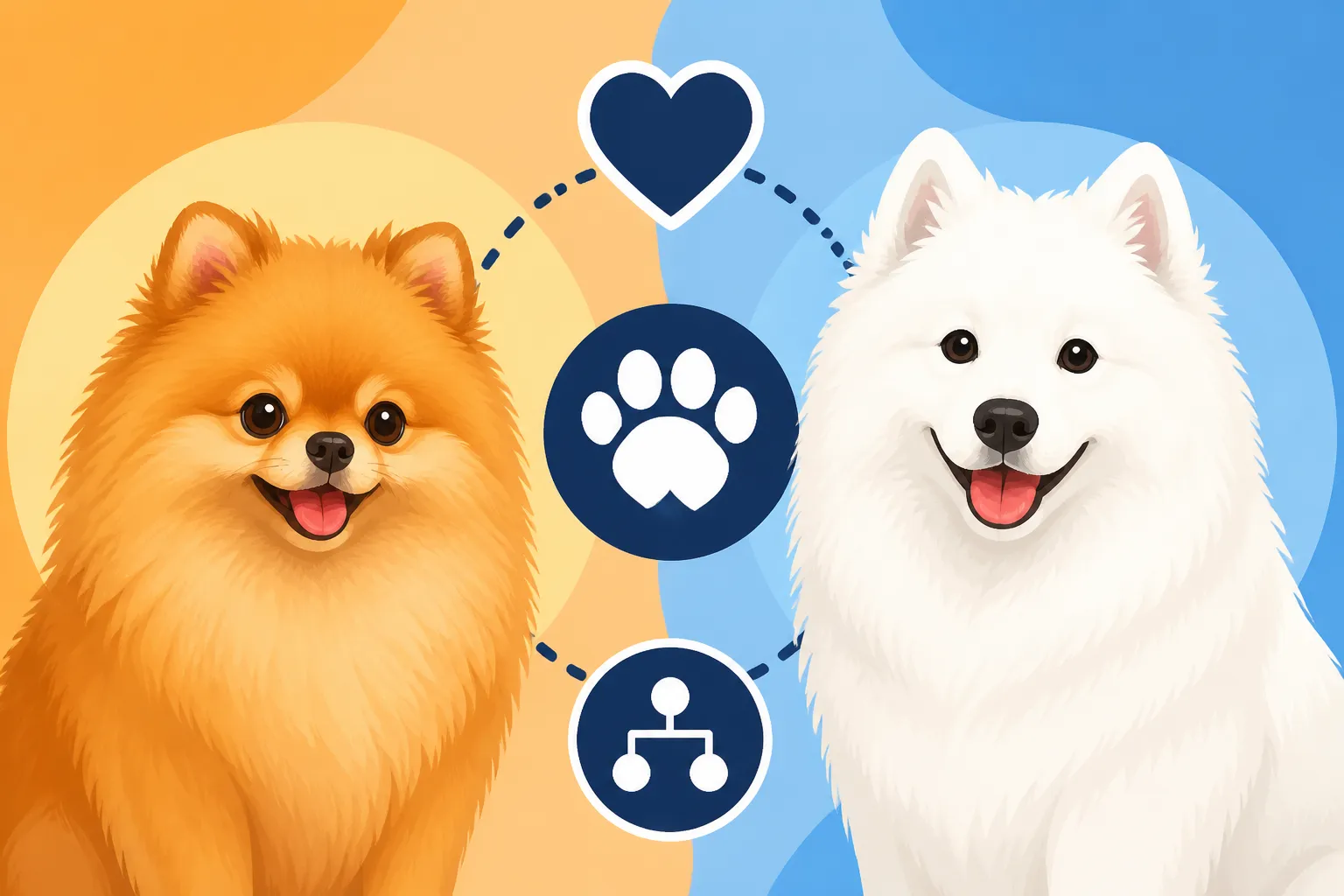
A Pomeranian’s foxlike face, pointed ears, and thick double coat can look strikingly similar to a Samoyed’s, just in miniature. That resemblance naturally raises a question: are Pomeranians descended from Samoyeds, or do the breeds simply share distant roots? This guide explains what their family connection likely means, what it does not prove, and how their histories and temperaments differ.
How Pomeranians and Samoyeds Are Related
They belong to the broader Spitz family
Pomeranians and Samoyeds are both members of the broad Spitz-type dog family. “Spitz” describes a group of dogs that often share features such as upright ears, a wedge-shaped head, a curled or carried-over-the-back tail, and a dense coat suited to cold weather. These similarities can make two Spitz breeds look like different-sized versions of one another, but appearance alone does not establish a direct parent-and-descendant relationship.
The Pomeranian’s breed history is associated with larger Spitz dogs from Pomerania, a historic region along the southern Baltic coast. Over generations, breeders selected smaller dogs, eventually producing the compact companion breed familiar today. The Samoyed, by contrast, developed as a northern working dog in Siberia, where it was used by Indigenous Samoyedic peoples for work that included herding reindeer and pulling sleds.
So the clearest answer is that the breeds are relatives in the broad sense: they share a wider Spitz background. There is no simple, well-established family tree showing that the Pomeranian descended directly from the modern Samoyed. For more context about the Pomeranian’s place among related breeds, see The German Spitz Family a Pomeranian Belongs To.
Shared ancestry is not the same as direct descent
Dog breeds formed over long periods through human selection, regional populations, and changes in the jobs dogs were expected to do. In that kind of history, two breeds can share older ancestors without one being the direct ancestor of the other. A Pomeranian and a Samoyed may both reflect traits found in northern and central European Spitz-type dogs, while developing separately in different places and for different purposes.
It helps to picture a branching family tree rather than a straight line. A smaller branch and a larger branch may connect far back in the tree, but that does not make one the miniature version of the other. The Pomeranian’s development is more closely tied to the German Spitz family and the reduction in size of larger Spitz dogs. The Samoyed’s history is tied to its own northern working environment and traditions.
The history of the Pomeranian’s larger ancestors is covered in The Working Spitz the Pomeranian Descends From. That background helps explain why a tiny lap-sized dog can still have a sturdy, alert, and confident manner associated with working Spitz breeds.
Why the Two Breeds Look Alike
Similar features reflect a shared type, not proof of a close family link
A thick coat, pointed ears, a curled tail, and a lively expression are common Spitz characteristics. They are also practical features: a dense coat offers insulation, erect ears can help a dog detect sounds, and a curled tail is part of the familiar outline seen in many breeds of this type. When two breeds share those traits, they can seem closely related even if their histories took different paths.
Their coats also create a strong visual resemblance. Both breeds have a substantial double coat, with a softer undercoat beneath longer outer hair. But coat color, body size, grooming needs, and the exact shape of the head differ considerably. A Samoyed is a large dog built for demanding outdoor work, while a Pomeranian is a toy breed whose coat frames a much smaller body.
A family comparing the breeds in photographs may notice how similar their silhouettes appear, especially when a Pomeranian’s coat is full. In person, the difference in scale is unmistakable. For more on the Pomeranian’s proportions and recognized size, see The Three to Seven Pounds a Pomeranian Is Allowed.
Breed looks can be misleading
Online listings sometimes use terms such as “mini Samoyed” or suggest that a Pomeranian is a Samoyed in miniature. Those labels can be confusing. A Pomeranian is not simply a small Samoyed, and the two breeds have distinct histories and breed identities. Marketing language or a resemblance in a photograph does not establish ancestry.
If you are considering a dog advertised as a Pomeranian-Samoyed mix, ask for clear information about its parentage and health history. A dog’s appearance alone cannot confirm that it is a cross. A responsible seller or rescue should be open about what is known and what is uncertain, rather than presenting guesses as proven lineage.
Breed identification can be especially tricky for mixed-breed dogs, since coats and facial features can resemble several breeds. Even a DNA test should be interpreted as an estimate of breed ancestry, not as a complete historical record. If you browse pet products or breed information on a retailer such as Chewy, remember that a product category or breed label is not a substitute for documentation about a particular dog’s background.
How Their Histories and Roles Differ
The Samoyed was developed as a working dog
The Samoyed’s history is closely connected to life in a harsh northern environment. These dogs were valued for work and companionship, including herding reindeer and pulling sleds. Their strength, endurance, and substantial coat suited them to a much more physically demanding role than the Pomeranian’s modern companion-dog life.
The Pomeranian’s ancestors were also larger and more robust than the modern toy breed. Over time, however, selection favored smaller dogs, and the Pomeranian became known primarily as a companion. This change in size did not erase every characteristic of its Spitz heritage. Many Pomeranians remain alert, energetic, vocal, and quick to notice movement around the home.
The two breeds therefore share a broad type but not the same working history. The question of whether Pomeranians themselves pulled sleds is explored in Whether the Pomeranian Was Ever a Sled Dog. The short version is that their distant ancestors belonged to a larger Spitz world, but the modern Pomeranian is not a sled-pulling breed.
Their size brings different day-to-day needs
A Samoyed generally needs space, exercise, and activities suited to a large, energetic working dog. A Pomeranian needs exercise and mental engagement too, but in a toy-sized body. Small size does not mean a dog should be treated like a fragile ornament; it does mean owners need to think carefully about handling, stairs, rough play, and interactions with much larger dogs.
Their grooming routines also require attention. Both coats need regular care, but a Pomeranian’s dense coat can mat close to the skin if it is not brushed thoroughly. Owners often find it easier to work in small sections, especially around the ruff, behind the ears, and where a harness rubs. When choosing a comb or brush, check that it suits a small dog’s coat and can reach through the outer hair without scraping the skin. Chewy is one place owners may compare grooming tools, though the right tool depends on the individual dog’s coat and comfort.
A Samoyed’s size also changes practical considerations such as food portions, exercise equipment, and safe transport. A Pomeranian’s needs are on a smaller scale, but not necessarily simpler. For a closer comparison of breeds in this group, see The Pomeranian Against the Other Toy Spitz Breeds.
| Feature | Pomeranian | Samoyed |
|---|---|---|
| Breed type | Toy-sized companion breed | Large working Spitz breed |
| Historical association | Larger Spitz dogs from Pomerania | Northern working dogs of Siberia |
| Common coat features | Dense double coat | Dense double coat |
| Typical role today | Companion and family dog | Companion and active working-style dog |
| Direct descent between the breeds | Not established | Not established |
| Shared connection | Broad Spitz-type ancestry and traits | Broad Spitz-type ancestry and traits |
What Their Relationship Means for Pomeranian Owners
A Pomeranian can have northern-looking traits without being a working sled dog
It is tempting to look at a Pomeranian’s coat and confident posture and imagine a tiny sled dog. The breed does carry traits associated with its wider Spitz heritage, but its daily needs should be based on the dog in front of you, not on a romanticized version of its ancestry. A short walk, play, sniffing time, and small training games can help keep a Pomeranian engaged without overdoing exercise.
Because Pomeranians are small, outdoor activities require sensible precautions. Keep a close eye on them around larger dogs, use a well-fitted harness rather than putting pressure on the neck, and avoid letting them jump down from high furniture. A dog with a compact body can still be energetic and brave, but size differences create real risks during play.
Their fluffy coat can also make it difficult to judge body condition by sight. Owners can learn to feel gently for the ribs rather than relying on the outline hidden beneath the fur. A lean, comfortable weight supports general mobility and can be especially helpful for a small dog. For more on the relationship between size and breed history, read How Breeders Selected Pomeranians Down in Size.
Choose a dog for its needs, not just its resemblance
If you are deciding between a Pomeranian and a Samoyed, think beyond coat color or face shape. Consider the amount of exercise you can provide, how much grooming fits your routine, your living space, and how comfortably you can manage a dog of each size. The Pomeranian is smaller, but still needs patient training, regular coat care, and careful handling. The Samoyed’s larger size and working background bring their own substantial commitments.
For prospective Pomeranian owners, a breeder or rescue should be able to talk candidly about the dog’s temperament, health, and care needs. A responsible breeder should also be willing to explain the breed’s history without claiming that a Pomeranian is simply a miniature Samoyed. If someone makes that claim to sell a puppy, ask follow-up questions and request clear records.
The Pomeranian’s confidence can surprise people who expect a tiny dog to be quiet or reserved. Some bark readily, and many are alert to sounds and movement. Their personality may echo qualities people associate with Spitz dogs, but individual temperament depends on many influences, including breeding, early experiences, and training. For a broader look at the breed’s resilience and vulnerabilities, see Whether a Pomeranian Is Hardier Than It Looks.
The simplest answer to the family-tree question
Pomeranians and Samoyeds are related broadly through the Spitz family and shared older ancestry, but the Pomeranian is not generally understood to descend directly from the Samoyed. The Pomeranian’s development is associated with larger Spitz dogs from Pomerania and later selection for smaller size. The Samoyed developed separately as a northern working breed.
Their similar coats and features make the connection easy to wonder about, but appearance does not tell the whole story. Thinking of them as distant relatives within a broad dog type is more accurate than thinking of one as the miniature form of the other. When you understand that distinction, their resemblance becomes more interesting: it reflects shared Spitz traits, while each breed’s history, size, and role remain its own.
Disclaimer
This article is for general informational purposes only and does not constitute professional advice. Laws, prices and regulations vary by location and change over time. Consult a qualified professional for guidance on your specific situation.