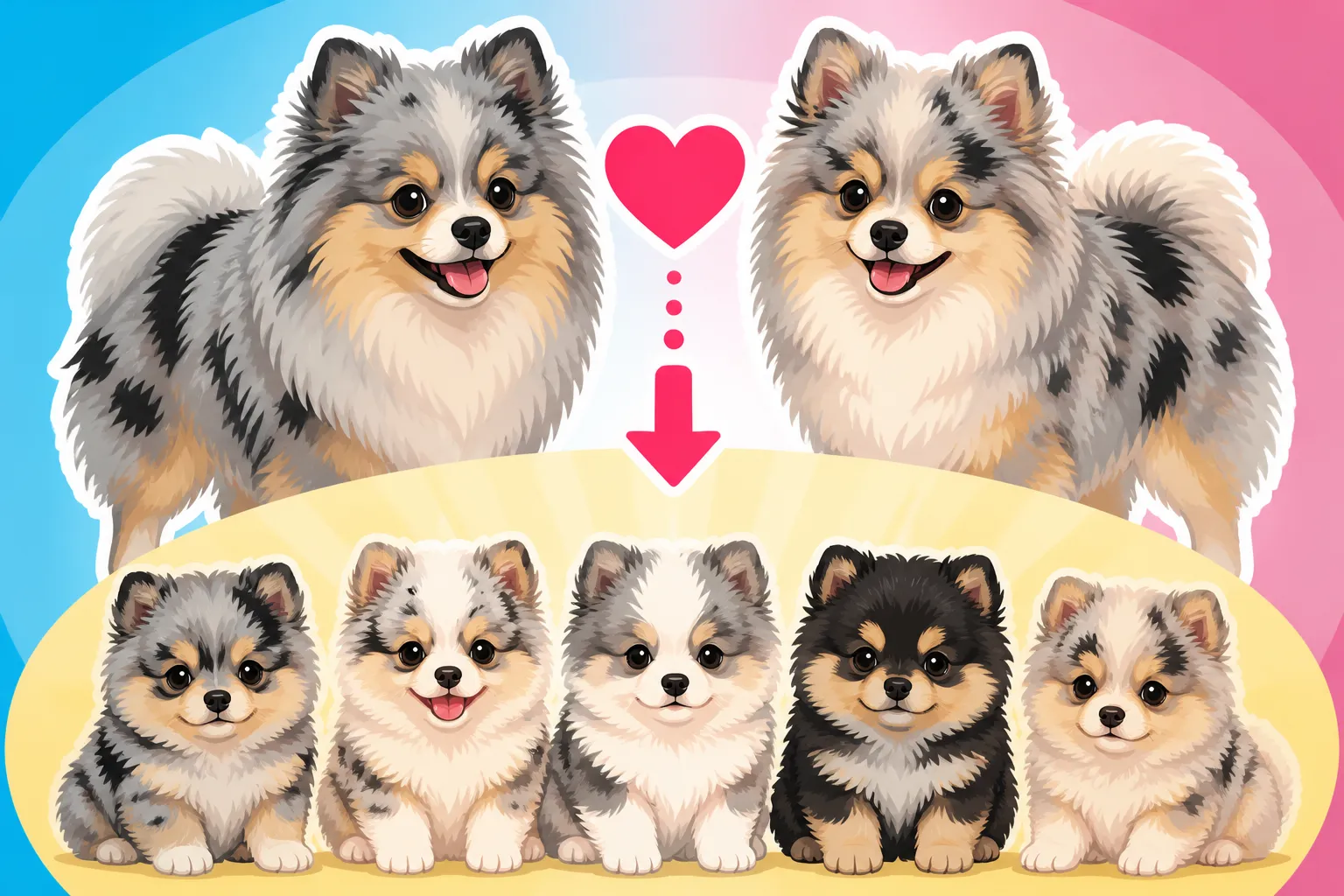
What Happens When Two Merle Pomeranians Are Bred
When two merle Pomeranians are bred, a litter can include puppies that inherit a merle variant from both parents. These double merles face a higher risk of hearing and eye abnormalities, though outcomes vary and no puppy’s health can be predicted from coat color alone. This guide explains the genetics, possible consequences, and responsible next steps.
How merle inheritance works in Pomeranians
What a merle pattern means genetically
Merle is a coat pattern caused by a variant affecting pigment distribution. It can create patches or mottling of lighter and darker color, sometimes with blue or partly blue eyes. A dog with one copy of the merle variant is commonly called a merle or single merle. A dog that inherits a copy from each parent is often called a double merle.
When both parents carry a merle variant, each puppy has its own chance of inheriting either parent’s version. If both parents are typical single merles, a simplified inheritance model gives each puppy about a one-in-four chance of inheriting two copies, a one-in-two chance of inheriting one copy, and a one-in-four chance of inheriting neither. These are expected proportions across many puppies, not a promise about any one litter. A small litter may have no double merles—or more than one.
Merle can be less obvious than people expect. A dog with only a small merle patch, a very pale coat, or a pattern hidden by other coloring may still carry the variant. This is one reason appearance alone is an unreliable way to decide whether two dogs can safely be paired. For more on how this pattern became part of the breed, see How Merle Got Into Pomeranian Bloodlines.
Why two merle parents raise a concern
The central concern is not simply that a double merle puppy may have an unusual coat. Inheriting two copies of the merle variant is associated with a greater risk of congenital problems affecting hearing and the eyes. Some affected puppies may be deaf, have impaired vision, or have structural eye abnormalities. The risk is elevated, but it does not mean every double merle puppy will have the same condition or that every puppy will be affected.
A puppy’s coat can sometimes provide a clue, but it cannot confirm what is happening inside the ear or eye. Some double merles have mostly white coats, while others may have visible patches of color. Likewise, a puppy with blue eyes is not automatically blind, and a puppy that reacts to sound during a casual home test is not necessarily free of hearing loss. Proper assessment takes veterinary examination and, when indicated, formal hearing testing.
This distinction matters because labels can be used loosely in online listings. A seller may call a puppy “rare” or “special” based on its coloring without explaining its parents’ genetics or the health checks performed. Merle-patterned Pomeranians and breeding choices around the pattern are discussed in Why Breed Clubs Object to Merle Pomeranians and Whether Merle Breeding Damages a Pomeranian's Eyes.
What may happen to puppies from a merle-to-merle litter
Hearing and vision outcomes are not all the same
Double merle puppies may be born with normal hearing and vision, or they may have partial or complete impairment in one or both senses. The effects can vary within a single litter. One puppy may hear normally while a littermate has significant hearing loss; another may have an eye abnormality that is not obvious without an examination. A white or heavily white coat may draw attention, but it is not a reliable diagnosis.
Deafness can be difficult to recognize in a young puppy. A puppy that sleeps through ordinary household sounds may simply be tired, and one that turns toward a noise may be responding to movement or vibration rather than hearing it. If there is concern, a veterinarian can advise whether a formal hearing evaluation, such as a brainstem auditory evoked response test, is appropriate. This kind of testing measures responses to sound more reliably than clapping or calling from across the room.
Eye concerns also deserve professional attention. A veterinarian can examine the eyes and refer the puppy to a veterinary ophthalmologist if needed. A puppy that bumps into objects, hesitates in dim light, or seems unusually sensitive to bright light should be assessed, but these signs are not specific to merle genetics. The related guide Why Double Merle Pomeranian Puppies Are Born Deaf explains why hearing concerns are part of the discussion.
| Inheritance outcome | What it generally means | What it does not tell you |
|---|---|---|
| No merle variant inherited | The puppy is not expected to show merle from this pairing | It does not guarantee freedom from unrelated health problems |
| One merle variant inherited | The puppy may show a merle pattern, though expression can vary | Coat appearance alone does not establish overall health |
| Two merle variants inherited | The puppy is a double merle and has a higher risk of congenital hearing or eye abnormalities | It does not prove the puppy is deaf or blind |
The table describes a simplified model. Actual inheritance and visible expression can be more complicated, which is why testing and professional interpretation are important before breeding.
Affected puppies can still need ordinary, loving care
A puppy with hearing or vision impairment is not automatically unable to enjoy a good life. Many dogs adapt well when their home is predictable and their people use safe, consistent ways to communicate. A deaf dog may learn visual cues or touch cues, while a dog with limited vision may rely more on familiar routes, scent, and gentle guidance. The practical work is real, though: family members need to use the same cues, supervise interactions, and avoid startling the dog.
For a very small breed such as the Pomeranian, safe handling and secure spaces matter regardless of sensory status. Use barriers around stairs or other drop-offs, supervise time on sofas and beds, and introduce visitors calmly. A Chewy order for a suitable gate or other basic safety supplies may help you set up a more predictable area, but a veterinarian or qualified trainer can help tailor the arrangement to an individual puppy’s abilities.
If a puppy is deaf, never rely on calling its name to prevent it from running into danger. Use a secure harness and leash outdoors, keep the dog within sight, and develop a consistent visual cue for attention. If vision is limited, keep furniture and food bowls in consistent places and guide the puppy gently through unfamiliar areas. A dog who cannot see or hear normally still benefits from play, training, affection, and companionship—just adapted to what the dog can comfortably manage.
Why responsible breeders avoid a merle-to-merle pairing
The risk is avoidable
A breeder cannot control which puppy inherits which combination of genes after two merle-patterned dogs are bred. That uncertainty is precisely why pairing two dogs that both carry the merle variant creates a preventable risk. Choosing a non-merle mate for a merle dog can avoid the double-merle pairing under the standard inheritance model, but responsible breeding still involves more than selecting coat colors. The health, temperament, structure, and family history of both dogs matter.
Genetic testing can help identify merle variants that are difficult to recognize by sight. It is sensible to ask what testing was done, which laboratory performed it, and how the breeder interpreted the result. Testing is a tool, not a blanket health guarantee: it does not rule out every genetic condition, and results should be considered alongside veterinary examinations and documented health history. If a seller cannot explain the parents’ status or dismisses questions about hearing and eye health, treat that as a reason to pause rather than a minor detail.
A breeder should be willing to discuss the risks plainly, show relevant records, and explain how puppies will be assessed and supported. Claims such as “the puppies are healthy because they have color” or “this pairing has never had a problem before” are not substitutes for testing and careful decision-making. For a broader look at breed standards and registration questions, read Whether a Merle Pomeranian Can Be Registered.
What a prospective buyer can ask
If you are considering a merle Pomeranian puppy, ask whether either parent carries a merle variant and whether the breeder has taken steps to avoid producing double merles. Ask what veterinary examinations the puppies have received and whether hearing or eye concerns have been assessed when appropriate. You can also ask to see the parents’ health records and clarify what support the breeder offers if a puppy later needs specialist care.
Pay attention to how those questions are received. A careful breeder may not have every answer at the first conversation, but should be open about what is known, what has been tested, and what remains uncertain. Pressure to send a deposit quickly, evasive answers, or promises that a rare coat color guarantees a rare-quality dog are reasons to slow down. Coat pattern is not a substitute for sound breeding practices.
It is also worth considering the full responsibility involved if you adopt a puppy with hearing or vision impairment. That may mean extra supervision, specialist follow-up, and changes to your home routine. Supplies can support daily care—such as a Chewy purchase of secure barriers or enrichment items—but no shopping list can replace thoughtful handling, training, and veterinary guidance. The decision should be about whether you can meet the individual dog’s needs, not whether its color is fashionable. See The Case Against Buying a Merle Pomeranian for more on weighing appearance against welfare.
What to do if a puppy may be a double merle
Arrange veterinary assessment instead of guessing from appearance
If you already have a puppy from a merle-to-merle pairing, contact a veterinarian and share what you know about the parents. Ask whether the puppy needs a hearing evaluation, a detailed eye examination, or referral to a specialist. Keep copies of any breeder-provided genetic results and veterinary records. The goal is not to assume the worst; it is to identify any needs early and make a sensible care plan.
At home, observe the puppy without turning ordinary behavior into a diagnosis. Notice whether it responds consistently to sounds when it cannot see the source, whether it navigates familiar and unfamiliar spaces comfortably, and whether its eyes appear cloudy, unusually shaped, or irritated. Write down specific observations and when they occur. A short video may help your veterinarian understand what you are seeing, but it cannot replace an examination.
Do not test hearing by making sudden, frightening noises close to the puppy’s ears. Do not use a phone flashlight or other bright light to try to diagnose vision problems. Gentle observation, a calm environment, and professional assessment are safer and more useful. If the puppy shows pain, eye redness, discharge, sudden disorientation, or a sudden change in how it responds, seek veterinary advice promptly.
Make daily life safe and predictable
A puppy with reduced hearing or vision often does best when the household is consistent. Use a secure leash outside, supervise closely around doors and stairs, and teach family members how to approach without startling the dog. With a deaf puppy, a gentle touch cue can be introduced when the dog is awake and relaxed; with limited vision, speak before touching and avoid moving familiar objects unnecessarily. Positive reinforcement helps the puppy learn without adding fear or confusion.
For households with children or other pets, supervision is especially important. A dog that cannot hear a warning growl or see a fast-moving child may be startled more easily. Teach children to let the puppy approach, avoid grabbing or waking it suddenly, and give it a quiet place to retreat. A gate or pen can create that safe space, and a Chewy order for suitable supplies may be one practical part of preparing the home. The most important part is consistent adult supervision.
Finally, avoid breeding any puppy based on appearance or assumptions about its health. A dog’s ability to hear or see does not determine its worth as a companion, but breeding decisions should not knowingly create avoidable risk for future puppies. If you have questions about the parents’ genetic results, a veterinarian can help you understand what testing means and what further assessment may be useful. For coat color changes and why appearance can be misleading, see Whether a Pomeranian's Color Changes as It Grows.
Disclaimer
This article is for general informational purposes only and does not constitute professional advice. Laws, prices and regulations vary by location and change over time. Consult a qualified professional for guidance on your specific situation.