Why Breed Clubs Object to Merle Pomeranians
A merle Pomeranian’s mottled coat can look striking, but the pattern raises questions that go beyond appearance: Is it accepted by breed organizations, how did it enter Pomeranian lines, and what health risks should buyers understand? This guide explains why breed clubs object, what merle genetics can mean, and how to assess a breeder’s claims without relying on coat color alone.
Why breed clubs object to merle Pomeranians
Breed tradition and the question of type
Breed clubs often focus on protecting a breed’s history, written standard, and recognizable type. Their concerns about merle Pomeranians may include whether the pattern fits the breed’s established color tradition and how breeders are producing it. Those are questions about breed stewardship, not simply whether an individual dog is attractive.
A dog’s merle coloring does not, by itself, prove that the dog is not a purebred Pomeranian. Purebred status depends on ancestry and documented pedigree. At the same time, a registry’s willingness to record a dog, a show standard’s treatment of a color, and a breed club’s support for breeding that color are separate matters. They should not be treated as interchangeable.
Policies and terminology can differ between organizations and countries. For that reason, check the rules of the registry or show organization that matters to you rather than assuming that “registered,” “recognized,” and “approved by the breed club” mean the same thing. For a closer look at the distinction, see Whether a Merle Pomeranian Is Recognized.
Concerns about how the pattern entered the breed
Merle is a coat pattern associated with a gene affecting pigment distribution. It is not a simple Pomeranian color label in the same way that orange or black is. Breed clubs and breeders may ask whether merle has a documented history in the breed or whether it was introduced through outcrossing at some point. The answer may not be clear from a puppy’s appearance or a seller’s description.
A merle dog may have a well-documented pedigree, or its ancestry may be uncertain. The pattern alone cannot settle that question. Buyers should be wary of confident claims that a dog is “rare,” “purebred,” or “from an old line” when the breeder cannot provide clear records and explain how the pattern appears in the pedigree. More background is available in How Merle Got Into Pomeranian Bloodlines.
Some objections are also practical. When breeders emphasize a fashionable or unusual pattern, buyers may have a harder time separating genuine health and pedigree information from marketing. A responsible breeder should be willing to discuss the dog’s parents, health screening, temperament, and breeding decisions—not just the color that attracts attention.
What merle genetics means for a Pomeranian
A merle coat does not tell the whole health story
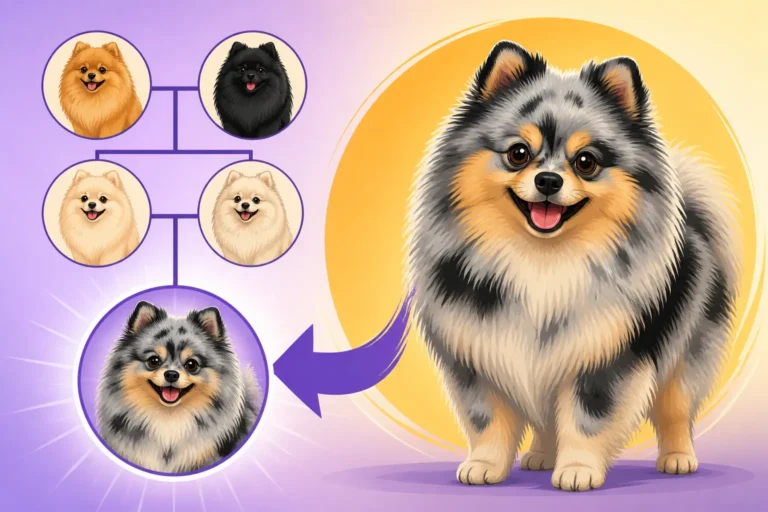
Merle describes an uneven distribution of pigment that can create lighter and darker patches. The pattern can vary from subtle to obvious, and it may occur alongside different base colors. A puppy’s coat can also change as it matures, so the appearance at a few weeks old may not show exactly how the adult coat will look. Whether a Pomeranian's Color Changes as It Grows explains why color descriptions can be confusing over time.
It is important not to jump from “merle” to “unhealthy.” A single merle allele does not automatically mean a dog will be deaf, blind, or otherwise ill. Health depends on many factors, including the dog’s individual genetics, breeding history, and overall care. The pattern is a reason to ask careful questions, not a diagnosis.
The higher-risk concern arises when a puppy inherits two merle copies. These dogs are often called double merles, and they can have a greater likelihood of hearing or eye abnormalities. Risk is not the same as certainty: not every double-merle dog has the same outcome, and appearance alone is not a reliable way to determine a dog’s genetic status. Read Why Double Merle Pomeranian Puppies Are Born Deaf and Whether Merle Breeding Damages a Pomeranian's Eyes for more detail.
Why the parent dogs matter
A responsible breeding plan considers what each parent can pass on. If two dogs carrying merle variants are bred together, puppies may inherit combinations that increase the risk of health problems. This can be more complicated than it looks because a dog may carry a variant that is difficult to identify by coat appearance alone. A breeder who relies only on visual inspection may miss information that matters when choosing a mate.
Ask whether the parents have had appropriate genetic testing and how the results informed the pairing. A good breeder should be able to explain the findings in plain language, share relevant documentation, and answer follow-up questions without dismissing concerns. A test result is useful evidence, but it should sit alongside veterinary care, pedigree records, and a broader health plan.
If a breeder says there is no risk because “the parents look different,” treat that as an incomplete explanation. Coat appearance cannot replace genetic information. You can also review The Papers a Pomeranian Breeder Should Provide when deciding what records and documentation to request.
| What you are checking | Why it matters | What a careful buyer can ask |
|---|---|---|
| Registry and show rules | Rules differ, and registration is not the same as breed-club approval | Which organization’s rules apply to this puppy? |
| Pedigree | Helps establish documented ancestry and clarify claims about a line | Can I review the pedigree and meet or learn about the parents? |
| Genetic testing | Can help identify merle variants that may not be obvious from appearance | What testing was done, and how did it guide the pairing? |
| Hearing and eye health | Some merle-related combinations can be associated with sensory concerns | What examinations or evaluations have been completed? |
| Breeder transparency | Clear answers help distinguish careful breeding from color-focused marketing | Can you explain the health, temperament, and breeding priorities? |
What to ask before buying a merle Pomeranian
Look beyond the puppy’s coat
It is easy to get swept up in a puppy’s appearance, especially when a listing describes a pattern as unusual or rare. Pause and ask whether the breeder puts the same attention into health, temperament, socialization, and lifelong support. A responsible breeder should want to know about your home and expectations, too; the conversation should not feel like a quick sale.
Ask for the names and details of the organizations or laboratories involved in any testing, and request copies of relevant records. Find out whether the puppy has had a veterinary examination and whether any hearing or eye concerns have been assessed. These questions do not imply that every merle Pomeranian has a problem. They help you understand what is known about the particular puppy and its family.
Be cautious if you hear that testing is unnecessary because the puppy “looks normal,” that documentation will only be provided after payment, or that health questions are an insult to the breeder. Good breeders can explain uncertainty honestly. For a broader discussion of the risks and considerations involved in choosing this color pattern, see The Case Against Buying a Merle Pomeranian.
Separate health concerns from marketing claims
A high price or a “rare color” label is not evidence of good breeding. Nor is a particular coat pattern proof that a dog is unhealthy or poorly bred. The useful question is whether the breeder can support their claims with records, clear communication, and a thoughtful plan for the dogs involved.
Watch for language that promises a puppy is guaranteed to be healthier, more valuable, or more special because of its color. Coat pattern is not a substitute for a sound temperament, appropriate care, or health screening. Likewise, a breeder’s use of terms such as “teacup” or “exclusive” should not distract you from basic questions about size, structure, and wellbeing. Whether a Pomeranian Is Being Bred Too Small offers useful context on why extreme size claims deserve scrutiny.
If you are comparing breeders, write down the same questions for each one. That makes it easier to notice which person answers directly and which keeps steering the conversation back to the puppy’s appearance. Keep copies of the pedigree, test results, veterinary paperwork, and contract so you can review them calmly rather than trying to remember details during an emotional visit.
Caring for a merle Pomeranian after bringing one home
Build a routine around the individual dog
Once a puppy is home, care should be based on its actual needs—not assumptions about its coat pattern. Arrange veterinary care, discuss any recommended hearing or eye evaluations, and share the breeder’s records with the clinic. If you notice that your puppy does not respond to sound, bumps into objects, squints, or has unusual eye movements, contact a veterinarian rather than trying to interpret the signs yourself.
Everyday care still matters. Use a well-fitted harness rather than putting pressure on a delicate neck, keep up with brushing, and teach handling gently from the beginning. If you are shopping for ordinary grooming or walking supplies, Chewy is one retailer where owners may find a range of pet-care items; whichever store you use, choose tools and equipment that suit your dog’s size and coat.
A pattern does not make a dog’s grooming needs fundamentally different, but a Pomeranian’s dense double coat does need regular attention. Work carefully through the coat rather than brushing only the surface, and ask a qualified groomer for help if mats are forming. Chewy may also carry basic brushes and grooming supplies, but buying a product is only one part of the job; technique and a calm, consistent routine matter just as much.
Keep health decisions grounded in veterinary advice
If a dog has a confirmed hearing or vision difference, a veterinarian can help assess what support is appropriate. Many dogs adapt well to sensory differences when their environment is predictable and their caregivers use consistent cues. Avoid startling a dog that may not hear an approach, and make home routines easier to navigate by keeping furniture and food-and-water locations steady.
For a dog with sensitive skin or areas of light pigment, ask your veterinarian how to manage sun exposure. Do not assume that a product intended for people is suitable for a dog. If you are considering pet sunscreen or protective clothing, ask your clinic what is appropriate for your dog and its lifestyle. Chewy can be a place to browse general pet supplies, but product selection should not replace veterinary guidance when skin or eye health is involved.
The most reassuring approach is to treat the dog in front of you as an individual. Merle coloring deserves informed questions, particularly about breeding and genetic combinations, but it should not be used to label every dog as sick or every breeder as irresponsible. Look for evidence, ask plainly, and give more weight to the dog’s welfare than to the appeal of a fashionable coat.
Disclaimer
This article is for general informational purposes only and does not constitute professional advice. Laws, prices and regulations vary by location and change over time. Consult a qualified professional for guidance on your specific situation.