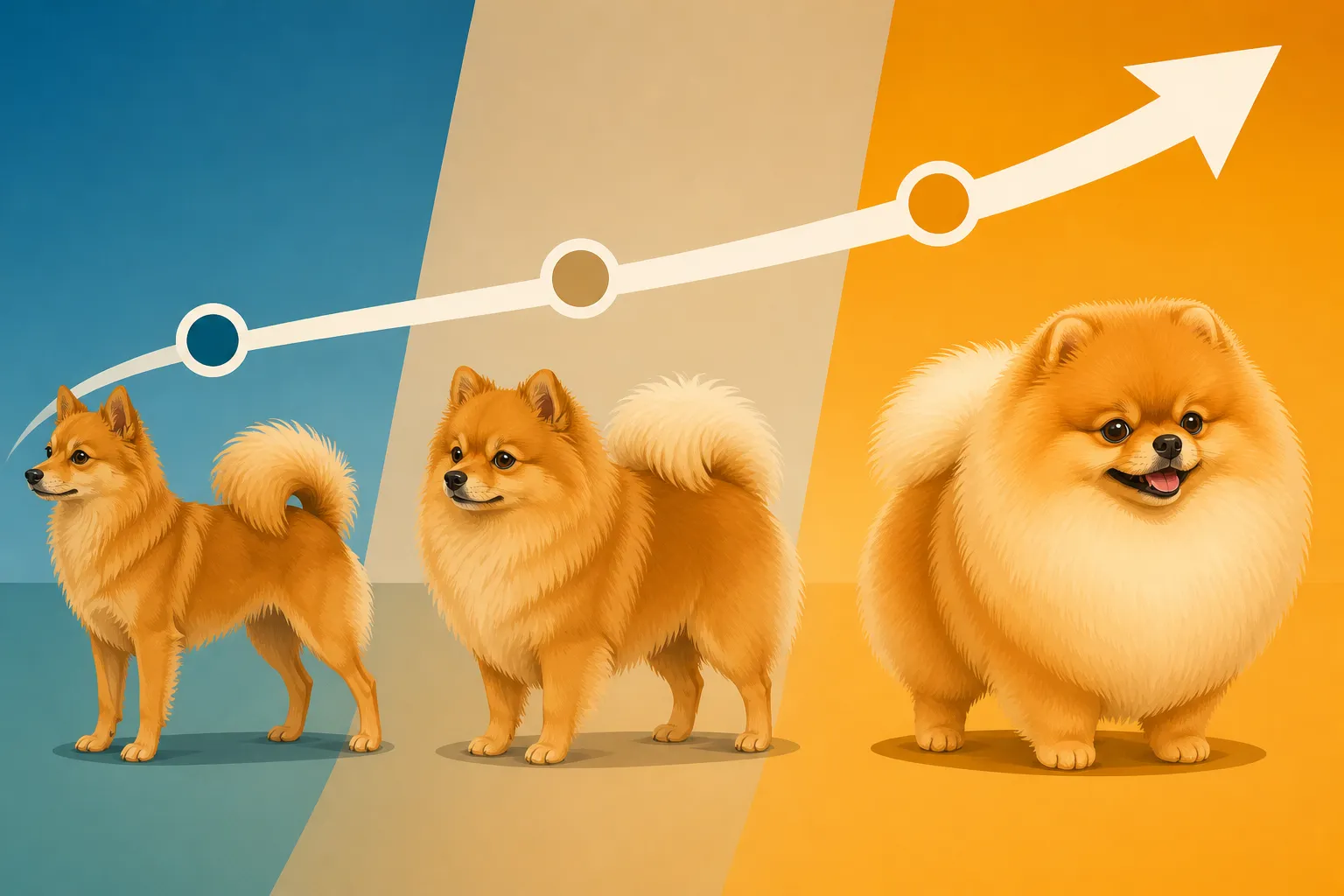
How Pomeranian Type Changed Across the Twentieth Century
A Pomeranian photographed in 1900 may look surprisingly different from one in a modern show ring. Over the twentieth century, selective breeding, changing show preferences, and grooming helped reshape the breed’s size and familiar outline. This guide traces those shifts decade by decade, explains what changed in the dog itself, and separates lasting breed traits from styles that can make Pomeranians look more different than they are.
Before the twentieth century the Pomeranian was already changing
From larger Spitz dogs to a small companion breed
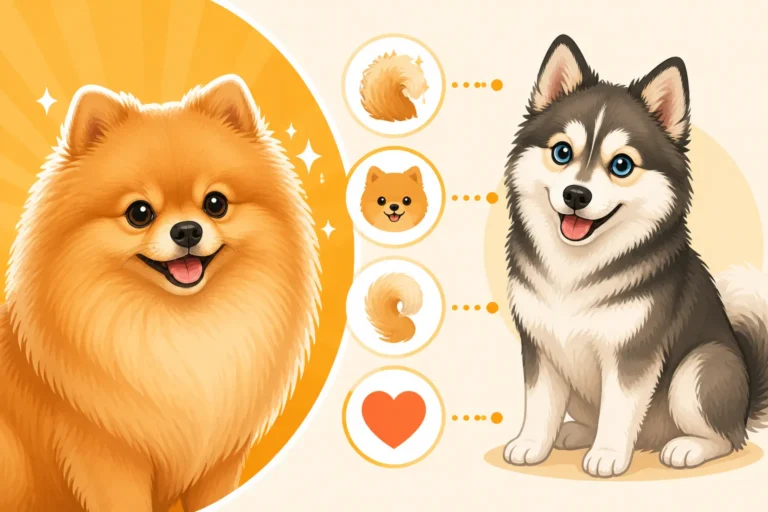
The Pomeranian belongs to the wider German Spitz family, a group of dogs known for erect ears, a curled tail, a thick coat, and an alert expression. Its ancestors were larger than the little companion dogs many people picture today. The transition to a smaller dog was not a sudden change at the start of the twentieth century; it was already underway during the preceding century.
That history matters because the Pomeranian did not begin with one fixed appearance and then simply stay the same. Breeders and owners shaped the breed over generations, selecting for smaller size while retaining recognizable Spitz features. For more background on that family resemblance, see The German Spitz Family a Pomeranian Belongs To.
By the time the twentieth century began, the Pomeranian was established as a small companion dog, but there was still variation in size and type. Individual dogs could differ in proportions, coat, and head shape, just as they do now. A photograph from the period is a snapshot of one dog, not a complete portrait of every Pomeranian being bred.
Victoria’s influence and a new ideal of smallness
Queen Victoria’s interest in Pomeranians helped raise the breed’s profile and encouraged public fascination with smaller examples. Her dog Marco is often mentioned in accounts of that popularity. The wider story is more complex than one famous dog, though: the breed’s reduction in size came through ongoing choices by breeders, not through a single owner or one dramatic generation.
As enthusiasm grew, small size became a more prominent part of the Pomeranian’s appeal. That shift affected expectations about what the breed should look like. To explore the role of Victoria’s dog in that history, see Marco, Victoria's Pomeranian, and the Year 1888. The larger dogs seen in earlier records are also useful context; The Twenty Five Pound Pomeranian of the 1800s looks back at a size that can surprise people accustomed to today’s toy-sized Poms.
How the twentieth century shaped Pomeranian type
Smaller size became more central
Across the twentieth century, the Pomeranian became more strongly associated with a compact, small-bodied companion. Breeders continued selecting for reduced size while aiming to keep the balance and lively character expected of a Spitz. This was a gradual process, not a uniform change that happened everywhere at once.
As a result, historical photographs can show a wider range of body sizes than many people expect. A dog that looks larger in an old image is not automatically a different breed, and a particularly small dog is not necessarily a better example of one. Size is only one aspect of type: proportion, soundness, coat, movement, and overall expression matter too. The long-term selection process is explored in How Breeders Selected Pomeranians Down in Size.
It is also easy to mistake perspective for actual size. A dog photographed beside a person, furniture, or another breed may look larger or smaller depending on the camera angle. When comparing pictures from different decades, look for several features at once rather than judging from a single visual cue.
The outline became more recognizable and more polished
The Pomeranian’s silhouette became increasingly familiar to modern viewers: a compact body, a profuse coat, a ruff around the neck, and a tail carried over the back. These traits did not appear all at once, nor did every dog develop the same abundance of coat. But as breed standards and show presentation gained influence, the expected outline became easier to recognize.
The coat plays a major role in that impression. A full double coat can make a small dog look rounder and more substantial, while a coat that is wet, changing, or recently shed may reveal a different body shape underneath. The breed’s stand-off coat is more than decoration; it is one of the features that contributes to the classic outline. See The Stand Off Coat a Pomeranian Must Have for more on how the coat affects appearance.
Grooming can also accentuate the outline. A tidy trim around the feet and a carefully brushed coat may make the dog appear especially polished, while an unstyled pet coat can look less sculpted. That difference is about presentation, not necessarily a different underlying type.
| Feature | Earlier twentieth-century Pomeranians | Common modern impression | What to keep in mind |
|---|---|---|---|
| Size | Greater visible variation in historical images | Strongly associated with a small companion-dog size | Photos can distort scale, and size alone does not define type |
| Head | Often appears less exaggerated in some period photographs | Frequently described as having a short muzzle and rounded expression | Individual dogs vary, and camera angle changes the appearance |
| Coat | Density and finish vary from dog to dog | Often looks abundant, especially in show presentation | Coat stage and grooming can dramatically alter the silhouette |
| Overall outline | Less uniform across historical photographs | Compact, profuse-coated, and highly recognizable | A polished outline can reflect grooming as well as breeding |
What changed in the head, coat, and overall expression
Head shape and expression became a stronger visual signature
The head is one of the quickest ways people think they can date or classify a Pomeranian. Modern examples are often associated with a shorter muzzle and a rounded, alert expression. But the breed has never been a collection of identical faces, and historical photos do not always offer a clear view of the head. Fur, lighting, facial expression, and the angle of the camera can all change what appears visible.
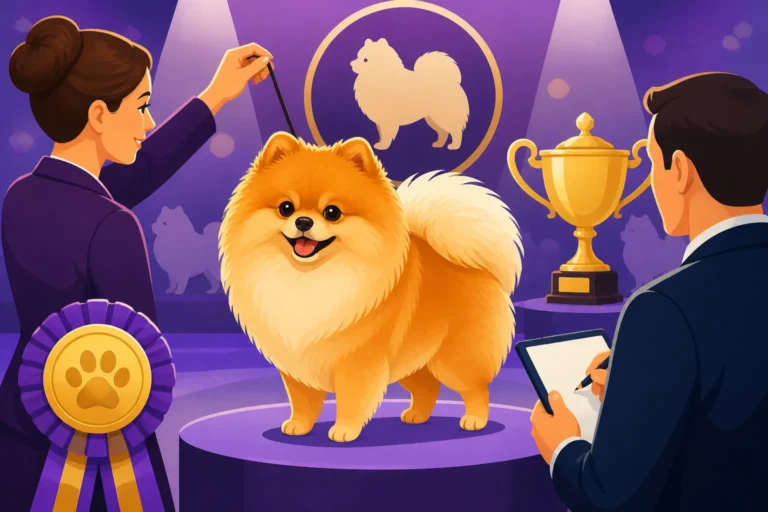
In the show ring, judges assess the dog as a whole rather than rewarding one isolated feature. The desired expression needs to fit the dog’s proportions and breed character. A short-looking muzzle in a photograph does not by itself prove that the dog represents a later type, just as a longer-looking face does not automatically place a dog in an earlier period. The Head and Expression a Pomeranian Judge Wants offers more context on the features considered in judging.
The popular labels “fox face,” “baby doll,” and “teddy bear” can make the history sound like a neat sequence of official types. They are better understood as descriptions people use for different looks, rather than as separate historical stages that every Pomeranian passed through. A modern dog may have a face people call “fox-like,” for example, without being a throwback to a particular decade.
Coat, color, and presentation changed what people noticed
Pomeranians have long been associated with a thick double coat, but the coat’s volume and finish can vary. As show presentation developed, the coat became a more prominent part of the breed’s visual identity. Brushing, drying, and trimming can emphasize the ruff and body outline, making one dog appear especially round or plush in a photograph.
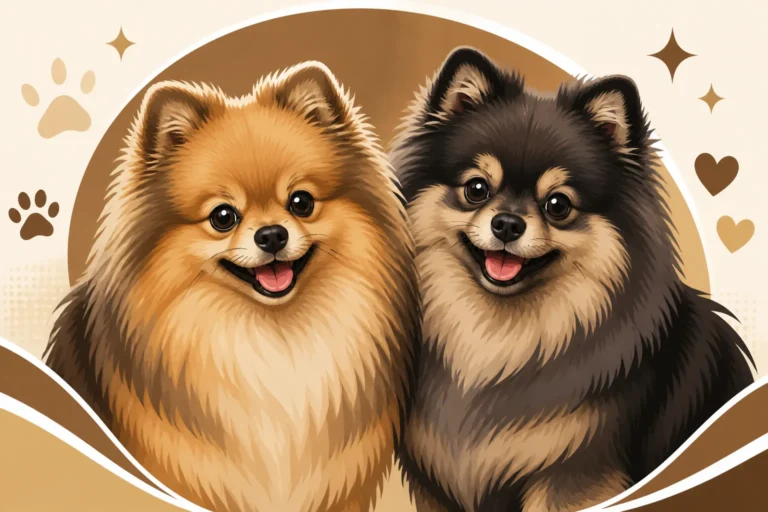
Color has also influenced which Pomeranians attract attention. The breed is seen in many colors and patterns, and popular preferences can shift over time. A color that is particularly visible in a photograph or popular in a certain period may seem more common than it was overall. Changes in fashion should not be confused with the basic structure of the dog.
When comparing old and new photographs, ask whether the dog is standing naturally, whether its coat is fully grown, and whether the image is a formal show portrait or an everyday snapshot. Those details often explain apparent differences before you need to assume that breeding changed the dog dramatically.
Why historical Pomeranians can look so different today
Show standards and breeding preferences are not the whole story
Breed standards give breeders and judges a shared description of the Pomeranian, but they do not make every dog identical. Breeders may emphasize different strengths within the accepted type, and the dogs shown publicly are only a small sample of all Pomeranians living as pets. A show photograph can make a breed appear more uniform than it is in ordinary homes.
There can also be differences in emphasis between countries and breeding programs. Those differences are best treated with care: a dog’s appearance may reflect its family line, grooming, age, and individual traits, not just where it was born. For a broader look at regional distinctions, see Whether an American and European Pomeranian Differ.
Historical images also have limits. Black-and-white photography obscures coat color, and early portraits may show a dog posed in a way that hides its proportions. Old photographs can be valuable clues, but they are not a complete record of the breed’s population or a reliable way to measure a dog’s exact size.
A practical way to compare Pomeranians across decades
If you are looking at a family photograph, an old dog show image, or a modern Pomeranian online, compare several things before deciding how much the breed has changed:
- Check the whole body. Look beyond the head and coat. Notice the legs, body length, tail carriage, and overall balance.
- Consider the coat’s condition. A puppy, a dog changing coat, and a fully coated adult can look dramatically different.
- Notice the setting and pose. A carefully posed show dog is not directly comparable to a candid household photograph.
- Treat labels cautiously. Terms such as “teddy bear” describe a look, not a distinct century-specific breed type.
- Look for repeated patterns. A handful of photographs cannot establish what all Pomeranians looked like in a particular decade.
The clearest story is one of gradual refinement rather than a complete transformation. Over the twentieth century, Pomeranians became more strongly associated with small size, a compact outline, a profuse coat, and a recognizable alert expression. At the same time, individual variation remained, and grooming and photography continued to shape what viewers thought they were seeing. Understanding both sides makes it easier to appreciate an old photograph without assuming that every difference represents a new kind of Pomeranian.
Disclaimer
This article is for general informational purposes only and does not constitute professional advice. Laws, prices and regulations vary by location and change over time. Consult a qualified professional for guidance on your specific situation.