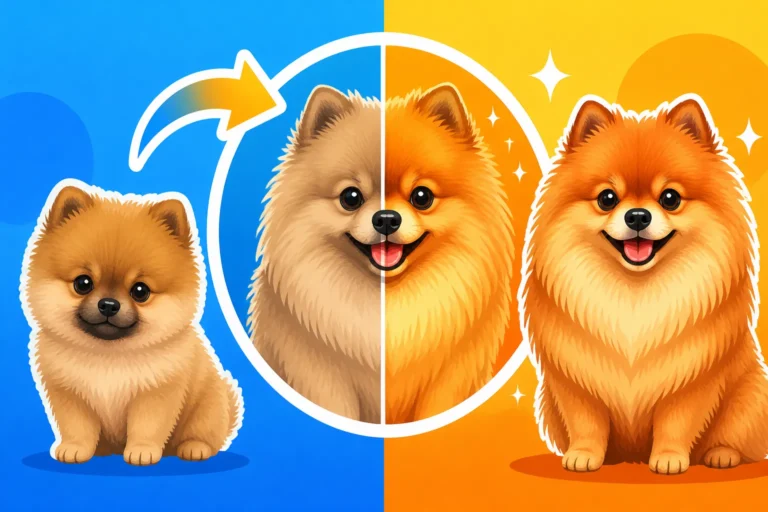
Whether Pomeranian Face Types Are Breeder Inventions
A Pomeranian puppy may be advertised as a “fox face,” “baby doll,” or “teddy bear,” leaving buyers to wonder whether these names describe real breed types. They don’t mark official varieties. This guide explains what the labels usually mean, how breeding and grooming affect a Pom’s appearance, and what to look at beyond a cute photo.
Are Pomeranian face types official breed categories
What the breed standard describes
Pomeranians are judged against a breed standard, not divided into fox-face, baby-doll, and teddy-bear categories. The standard describes a compact dog with a distinctive expression and head shape; it does not establish separate face-type varieties. For a broader explanation of the breed’s expected appearance, see The Head and Expression a Pomeranian Judge Wants.
That distinction matters when you’re comparing puppies. A breeder may use a face label to make a description easier to picture, but the label doesn’t tell you that the dog belongs to a separate recognized type, line, or class. Two littermates can look noticeably different and still both be Pomeranians.
If you see similar labels in a breed description or shopping content on a site such as Chewy, treat them as informal descriptors rather than official classifications. The wording can help communicate a look, but it shouldn’t substitute for information about the puppy’s health, temperament, parents, and care.
Why buyers see the same labels again and again
The names are popular because they’re memorable and visual. “Fox face” suggests a longer, narrower-looking muzzle and a more pointed expression. “Baby doll” and “teddy bear” usually suggest a rounder-looking head, shorter-looking muzzle, and softer expression. These are loose impressions, not measurements with agreed boundaries.
A breeder’s use of a term may not match another breeder’s definition. One person might call a puppy a teddy bear because its cheeks look full under a plush coat; someone else might reserve the term for a noticeably short muzzle. There’s no universal measuring system that makes the label consistent across advertisements.
This is why a photo can be misleading. Coat length, grooming, camera angle, and even a puppy’s age can change how a face appears. A close-up taken from slightly above may make the muzzle look shorter than it is, while a freshly fluffed coat can make the head look rounder. When comparing dogs, look at several natural photos and videos rather than relying on one carefully posed image.
How breeders influence the look
Breeders choose which dogs to mate, and those choices can influence appearance over generations. If a breeder repeatedly prefers certain head shapes or expressions, puppies may tend to show more of those traits. But that does not make a marketing label an official type, nor does it mean every puppy in a litter will have the same face.
A breeder may describe a puppy as a “baby doll” because buyers ask for that look, because the puppy’s face seems round in its current coat, or simply because the phrase is familiar. The label alone doesn’t reveal how the parents look, what traits run in the family, or how the puppy may change as it matures.
For that reason, ask to see the puppy’s parents when possible, and ask the breeder to explain what they mean by the term. A trustworthy answer should be specific and realistic, not a promise that a puppy will keep an exact face shape for life. You can also compare the description with Whether Pomeranian Face Types Are Breeder Inventions and the broader discussion of Fox Face, Baby Doll and Teddy Bear Pomeranians.
What fox face, baby doll, and teddy bear usually mean
Fox face
“Fox face” usually describes a Pomeranian whose muzzle looks longer or more tapered and whose expression appears sharper. The term is often used for a look that feels closer to the classic spitz expression. It doesn’t mean the dog is a different breed, and it doesn’t guarantee a particular adult appearance.
The impression depends on more than the bones of the face. A puppy’s coat may be in a transitional stage, and the hair around the cheeks and muzzle can change how narrow or broad the head appears. Age matters too: puppies often look different as their adult coat comes in and their proportions mature.
If you’re drawn to a fox-like expression, ask for photos of the puppy at different ages and of related adult dogs. That gives you a more grounded idea than a label alone. The general breed description is helpful here, including What Breeders Mean by a Fox Face Pomeranian.
Baby doll and teddy bear
“Baby doll” and “teddy bear” are commonly used for a rounder, softer-looking face. In many listings, the words are nearly interchangeable, even though different breeders may use them differently. They usually describe an impression rather than a recognized anatomical category.
A dense coat can create a round silhouette around the face, and grooming can accentuate that effect. Rounded trimming around the cheeks and ears may make the head look more circular, while a different trim can make the muzzle seem more prominent. The dog’s expression, coat color, and the way the photo is lit all contribute.
These labels can also carry emotional appeal. “Baby doll” may make a puppy sound extra delicate, while “teddy bear” evokes a plush toy. Cute language isn’t automatically a warning sign, but it should never be the main evidence for choosing a puppy. Look beyond the sales description, and consider Where the Baby Doll Pomeranian Face Came From for more context.
Why the labels aren’t a reliable forecast
A puppy’s face changes as it grows. The coat can become fuller, change texture, or shift in color; the head may look different as the puppy’s proportions mature. A seller may call a very young puppy a teddy bear based on its current appearance, but that phrase cannot guarantee how its adult face will look.
Pictures also vary in perspective. A camera close to the nose can exaggerate or minimize parts of the face, and a puppy looking slightly upward may appear to have a shorter muzzle. If you are comparing several puppies remotely, ask for unfiltered photos taken at a similar distance and angle, plus a short video showing the puppy moving naturally.
You can ask the breeder direct questions: “What do you mean by teddy bear?” “Do the parents have a similar look?” “Can I see adult dogs from this line?” These questions are more useful than debating a label whose meaning may change from one listing to the next.
| Label | Common impression | What it does not establish |
|---|---|---|
| Fox face | A more tapered or longer-looking muzzle | A separate breed or guaranteed adult head shape |
| Baby doll | A rounder, softer-looking expression | An official variety or health status |
| Teddy bear | A plush, rounded appearance | A standardized measurement or predictable coat-and-face outcome |
How to judge a Pomeranian beyond its face label
Prioritize health and responsible breeding
A puppy’s facial appearance is only one part of the decision. Ask about the parents’ health, veterinary care, and the breeder’s approach to selecting breeding dogs. A responsible breeder should be willing to discuss the puppy’s background and answer reasonable questions without pressuring you to pay quickly.
Be cautious if a breeder relies on dramatic claims such as “rare face type,” “perfect teddy bear,” or “guaranteed tiny adult” while offering little practical information. A label can be used to describe a look, but it cannot replace veterinary records, clear information about the parents, or an honest conversation about the puppy’s needs.
If you’re considering a very small Pom, appearance claims deserve even less weight than sound health information. Small size and a cute face can attract attention, but size-related concerns are worth understanding separately. See Whether Teacup Is a Real Pomeranian Category and The Three to Seven Pounds a Pomeranian Is Allowed for context on size terminology and breed expectations.
Look at the whole dog and its behavior
Meet the puppy if you can, or request a live video conversation if an in-person visit isn’t practical. Observe how the puppy moves, responds to ordinary activity, and interacts with people. A single posed portrait can’t tell you whether the puppy is alert, comfortable, or being presented in a typical setting.
Ask about daily care, feeding, social experiences, and what support the breeder offers after the puppy goes home. A breeder who knows the litter well should be able to tell you about individual temperaments, not just which puppy has the roundest face. If a seller avoids these questions and keeps returning to appearance or urgency, take a step back.
It can help to write down your priorities before contacting breeders. For example, you may care most about a healthy, confident companion, a manageable grooming routine, and a breeder who remains available for questions. A face label can be a preference, but it should not outrank those practical considerations.
Separate face shape from coat and grooming
A Pomeranian’s coat contributes greatly to its outline. The breed has a double coat, and the hair around the cheeks, ears, and neck can make the head seem broader or rounder. Grooming choices can further emphasize or soften that outline, so a “teddy bear” appearance may partly reflect styling rather than a unique head type.
Before choosing a puppy based on a particular look, learn what routine coat care involves. A fluffy face may look low-maintenance in a photo, but the coat still needs appropriate brushing and care. The Double Coat That Makes a Pomeranian and Why It Stays On explains why the coat’s structure matters, while Trims a Pomeranian Can Safely Have covers grooming choices without treating a haircut as a permanent face category.
If you’re browsing descriptions or care information on sites such as Chewy, keep the same distinction in mind: a breed label can help you recognize the general kind of dog being discussed, but it isn’t a substitute for advice tailored to an individual Pom. When a concern involves breathing, eating, eye comfort, or dental health, ask a veterinarian to assess the dog rather than trying to infer health from a “face type.”
Questions to ask before choosing a puppy
Ask what the breeder means by the term
Start with an open question: “You describe this puppy as a baby doll. What features are you referring to?” The answer may clarify that the breeder means a round-looking coat, a short-looking muzzle, or simply a soft expression. If the breeder cannot explain the term beyond “it’s rare” or “everyone wants one,” treat the phrase as sales language rather than useful information.
Then ask whether the puppy’s parents have a similar appearance and whether the breeder has photos of adult dogs from related litters. This will not guarantee what your puppy will look like, but it may help you understand the family’s general range of appearance. A fair answer should acknowledge that puppies change as they grow.
You can also ask how the puppy’s photos were taken and whether the coat has been trimmed or styled. There is nothing wrong with grooming a dog neatly, but knowing what you’re seeing helps you avoid confusing a styled silhouette with a fixed anatomical feature.
Keep expectations realistic
It’s reasonable to have a preferred look. Many people are drawn to a particular expression, just as others prefer a certain coat color. The key is to treat that preference as one factor, not a promise that a puppy will match a photo forever.
If a breeder promises an exact adult face, ask what that promise is based on. Even experienced breeders cannot control every aspect of how a puppy develops. A puppy’s coat, proportions, and expression may change, and online images can create expectations that are difficult for any dog to meet.
A useful final check is to ask yourself whether you would still be happy with the puppy if its adult face looked less round or more tapered than expected. If the answer is yes, you’re choosing a companion rather than buying a guaranteed appearance. If the answer is no, it may be worth slowing down and reconsidering what matters most to you.
Use retailer and breed descriptions as a starting point
Breed descriptions can help you learn common traits, but informal face labels should be read carefully. A retailer such as Chewy may be one place people encounter general breed information while researching dog care; a breeder’s listing, social post, or advertisement may use the same phrase in a more sales-focused way. In either setting, ask whether the term is descriptive or official before treating it as a fact.
When you need to evaluate a puppy, direct information is more useful than a search result snippet: talk with the breeder, review the available health records, and arrange a veterinary examination after bringing the dog home. A veterinarian can assess the puppy’s overall condition and answer questions that a label cannot resolve.
The clearest takeaway is simple: fox face, baby doll, and teddy bear are informal descriptions of appearance, not official Pomeranian types. Use them to understand what a seller is trying to convey, then look beyond the wording to the puppy’s health, background, temperament, and care.
Disclaimer
This article is for general informational purposes only and does not constitute professional advice. Laws, prices and regulations vary by location and change over time. Consult a qualified professional for guidance on your specific situation.