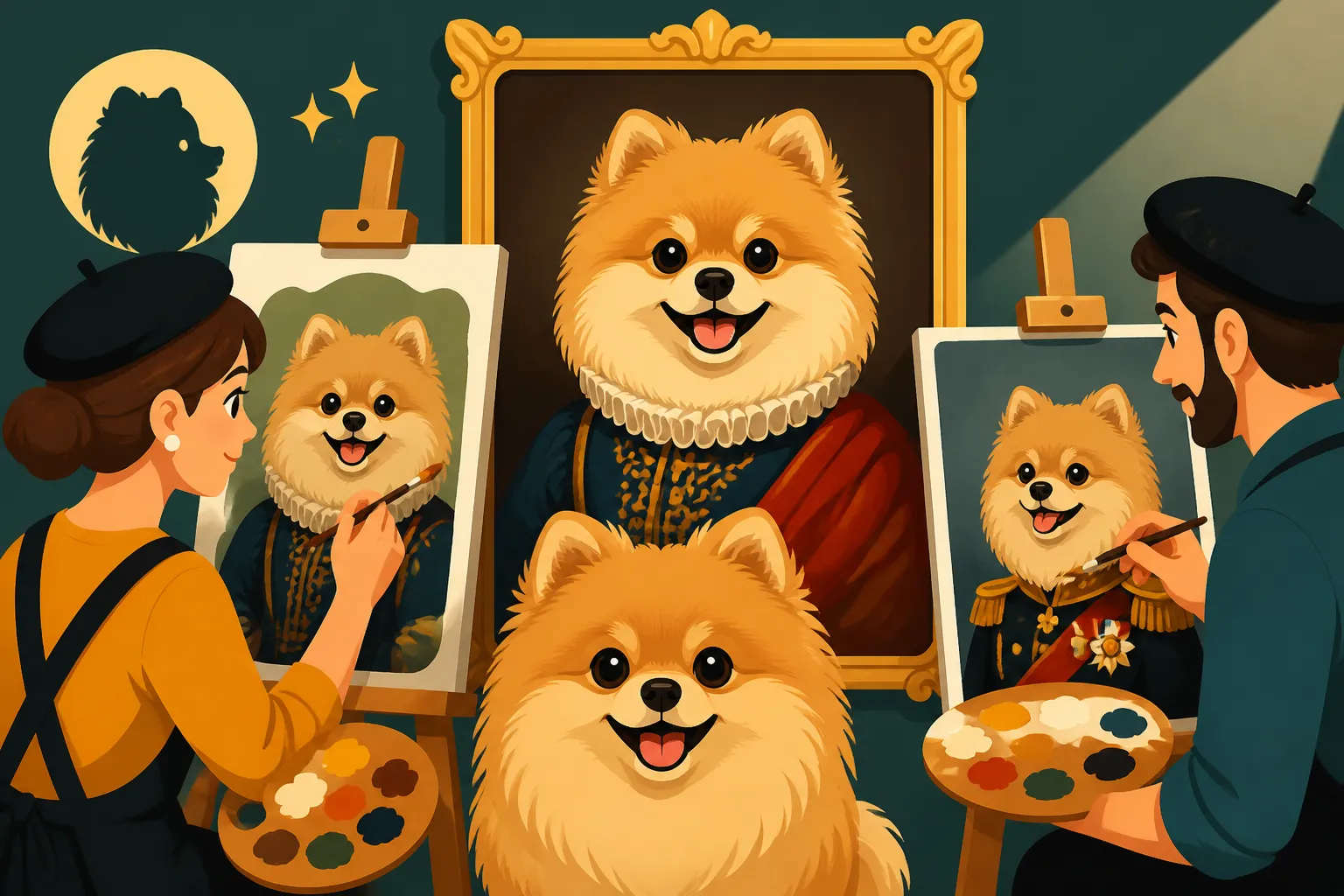
The Painters Who Put Pomeranians in Portraits
A small, fluffy dog in an old portrait can look unmistakably like a Pomeranian, yet assigning a modern breed name to a centuries-old image is often harder than it seems. Breed labels changed, artists idealized their subjects, and many spitz-type dogs shared similar coats and faces. This guide explains which painters and portraits offer useful clues—and where certainty ends.
Why Pomeranians Appear Differently in Historical Portraits
The breed name did not always mean the same thing
Pomeranians belong to the broader spitz family, a group of dogs known for pointed ears, curled tails, dense coats, and alert expressions. The breed’s name comes from Pomerania, a region on the southern Baltic coast, but a dog described as a “Pomeranian” in an older document might not match the compact toy breed people picture today. Earlier dogs were generally larger, and the type gradually changed through selective breeding.
That difference matters when looking at art. A dog with a fluffy coat and foxlike face might be a Pomeranian, another German Spitz, or simply a small companion dog painted with the features fashionable at the time. The image can suggest a family resemblance without proving a precise breed. For the background, see The German Spitz Family a Pomeranian Belongs To and Pomerania and the Sled Dogs Behind the Pomeranian.
Even the word “portrait” can mean different things in this context. Some pictures are formal portraits of people with a dog included as a companion or status symbol. Others are studies of the dog itself, or decorative scenes where the animal’s identity was never recorded. A painting’s original title, later catalog descriptions, and the dog’s appearance may not tell the same story.
Artists shaped the dog as much as they observed it
Painters rarely aimed to create a scientific breed record. They worked to capture character, status, elegance, and the relationship between a person and a pet. A long coat might be exaggerated to make a dog look more impressive; a shortened muzzle or rounded head could reflect artistic style rather than a feature of a distinct breed.
Portraits also changed with the tastes of their patrons. A fashionable lapdog might be positioned close to its owner, dressed with a ribbon, or painted with a particularly abundant coat. Those details are useful for understanding how people valued companion dogs, but they do not establish that the animal was a Pomeranian by today’s breed standard.
A careful viewer therefore asks two questions at once: What kind of dog does the painting seem to show, and what evidence exists outside the image? A contemporary letter, inventory, or caption naming the dog can strengthen an identification. Without that kind of evidence, it is more accurate to say “spitz-like dog” or “possibly a Pomeranian” than to treat a visual resemblance as proof.
Painters and Portraits Worth Looking At
Jean-Baptiste Oudry and the tradition of animal portraiture
Jean-Baptiste Oudry, a French painter known for detailed depictions of animals, is one of the artists whose work is relevant when tracing the history of dog portraiture. Paintings and catalog descriptions associated with small spitz-type dogs are sometimes discussed as Pomeranian images. The key is to check how a particular work is titled and described by the collection that holds it, since catalog wording can vary over time.
Oudry’s importance is broader than any single breed label. His animal paintings show how artists could give a dog individuality: posture, gaze, coat texture, and the small signs of attention that make an animal seem present rather than ornamental. Those qualities can help viewers compare historical dog imagery without claiming that every fluffy, pointed-eared subject belongs to the modern Pomeranian breed.
When looking at an image attributed to Oudry, notice the dog’s proportions as well as its coat. Does it have a compact body? Erect ears? A tail carried over the back? These features may resemble a Pomeranian, but they also occur in other spitz breeds. The painting is a valuable piece of visual history, not a substitute for a documented pedigree.
Gainsborough, Stubbs, and the challenge of identification
Thomas Gainsborough and George Stubbs are often part of conversations about historical dog imagery because both painted animals and people with pets. Their work provides a useful way to explore how dogs appeared in British portraiture, but a dog in a painting by a well-known artist should not automatically be called a Pomeranian. The name may come from a later caption, a collector’s description, or a modern interpretation rather than a reliable record from the time.
The same caution applies to other celebrated dog painters, including Edwin Landseer. An artist’s reputation for painting dogs does not mean that every small companion dog in the artist’s work can be identified by breed. When a specific painting is being discussed, look for its title, date, provenance, and the wording used by the museum or collection that catalogues it. If those details do not name the breed, qualify the identification.
This distinction can feel frustrating when a dog looks so much like a Pom. The resemblance is still worth noticing; it may reveal that fluffy companion dogs with spitz-like traits were admired long before the modern breed was standardized. But it is more satisfying—and more historically honest—to describe what the image actually shows than to force it into a present-day label.
| What to examine | What it may tell you | What it cannot prove on its own |
|---|---|---|
| Pointed ears and a curled tail | The dog may have spitz-type features | That it is a modern Pomeranian |
| A dense, fluffy coat | The dog was painted with a full coat or was naturally well coated | Its exact breed or grooming routine |
| The painting’s original title | How the work was identified at a particular time | That the title is contemporary with the painting |
| Letters, inventories, or family records | A possible name, owner, or breed description | A modern pedigree |
| Museum or collection catalog notes | How specialists currently describe the work | That every historic identification is beyond dispute |
From Royal Companions to the Modern Pomeranian
Queen Charlotte and the larger dogs of an earlier era
Queen Charlotte, wife of George III, is often mentioned in discussions of early Pomeranians because her household was associated with dogs identified as Pomeranians. That history provides an important bridge between the broader spitz dogs of earlier centuries and the smaller breed familiar today. It also helps explain why historical references to Pomeranians may describe dogs that look noticeably larger than modern show or companion Poms.
Queen Charlotte’s connection to the breed is part of a wider story about royal and aristocratic interest in companion animals. Dogs in formal portraits could signal affection, wealth, refinement, or access to fashionable pets. Their presence tells us something about the role dogs played in domestic life, even when a painting does not identify the animal by name.
For a closer look at the breed’s royal associations and later transformation, explore Queen Victoria, Marco and the Pomeranian, The Twenty Five Pound Pomeranian of the 1800s, and How Breeders Selected Pomeranians Down in Size. These histories help put portraits in context: the Pomeranian did not simply appear fully formed as the tiny, abundant-coated dog seen today.
Queen Victoria, Marco, and the later portrait tradition
Queen Victoria’s interest in Pomeranians helped bring attention to smaller examples of the breed. Her dog Marco is especially well known in accounts of this period. As the breed became more fashionable, images of Pomeranians and similar dogs could circulate more widely through portraits, prints, and popular culture. That made the dog more visible, though it did not make every painted spitz a confirmed Pomeranian.
The safest way to connect a particular artist with a royal dog is to look for direct documentation: a named portrait, an archival description, or a record identifying the dog and painter. General statements that a painter worked for a royal household or painted dogs are not enough to confirm that a specific Pomeranian appears in a specific work. This is one reason popular retellings sometimes make stronger claims than the surviving evidence supports.
Victoria’s era also marks a period when the breed’s appearance was changing. A viewer comparing an older painting with a modern Pomeranian may notice differences in size, coat, or head shape. Those differences are not necessarily evidence that the old image is misidentified; they may reflect the long development of the breed. For more on this turning point, read Marco, Victoria's Pomeranian, and the Year 1888.
How to Read a Pomeranian in a Painting
Look for a cluster of traits, not one signature feature
A curled tail, upright ears, and a full coat can make a dog look Pomeranian-like, but no single feature settles the question. Look at the overall outline: body size relative to nearby people or furniture, leg length, head proportions, coat volume, and how the tail is carried. Then consider whether the artist might have altered those proportions for visual effect.
Coat details can be especially misleading. Artists sometimes used broad strokes or soft outlines that make a dog seem fluffier than it was. A historical grooming style may also differ from the familiar modern silhouette. The coat in a painting is evidence of how the dog was represented, not a precise record of its undercoat, texture, or everyday condition.
Modern owners who want to understand that dramatic outline can learn about the breed’s characteristic coat in The Stand Off Coat a Pomeranian Must Have. If a portrait inspires you to care for a Pom’s coat, remember that contemporary grooming is about keeping the skin and coat healthy—not recreating an artistic shape at all costs. Chewy carries grooming supplies for pet owners, but a brush should suit the individual dog’s coat and comfort rather than a look in a painting. A suitable comb or brush can also be discussed with a groomer or veterinarian.
Verify the artwork before repeating a breed claim
Start with the work’s full title and the collection or institution that holds it. Check whether the catalog calls the dog a Pomeranian, a Spitz, or simply a dog. If the painting is known by different titles, note that descriptions may have been revised or standardized long after the artist’s lifetime. A museum label is useful evidence, but it is still important to distinguish a documented identification from a modern interpretation.
Next, search for records connected to the owner or sitter. Letters, household inventories, exhibition catalogs, and contemporary newspaper accounts may identify a dog more clearly than the painting itself. If those sources are unavailable, describe the dog by its visible features and say that its breed is uncertain. That phrasing is not evasive; it is a fair account of what the evidence can support.
Finally, be cautious with social media captions and image-search labels. A familiar-looking dog can attract a confident breed name that gets copied from post to post without a source. When researching a portrait, save the artist, title, date, collection, and the exact wording used in the catalog. If the image makes you curious about Pomeranian colors or historical coat variation, Every Color a Pomeranian Comes In offers a modern breed-focused point of comparison. Chewy may be a practical place to browse everyday grooming basics, but shopping descriptions cannot establish what breed a centuries-old painted dog was.
The most rewarding portraits are often the ones that leave room for uncertainty. They let us see how people lived with dogs, what kinds of companions they admired, and how artists translated a pet’s personality into paint. A Pomeranian-like dog in a painting may not be a provable modern Pom, but it can still be part of the breed’s larger visual and cultural history. For owners inspired by those images, Chewy is one retailer to consider for routine coat-care tools, while a groomer can help match those tools to a real dog’s needs.
Disclaimer
This article is for general informational purposes only and does not constitute professional advice. Laws, prices and regulations vary by location and change over time. Consult a qualified professional for guidance on your specific situation.